
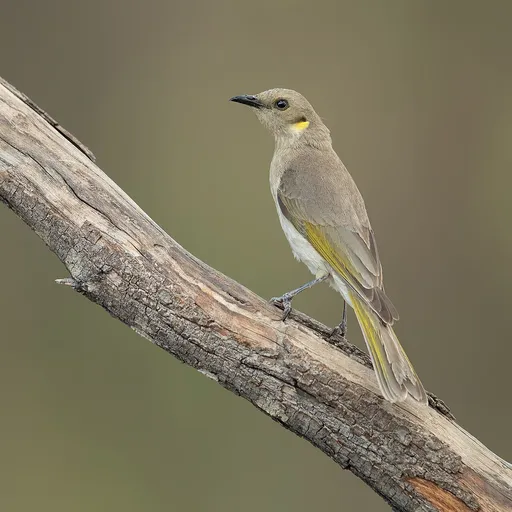
Fuscous Honeyeater
Ptilotula fusca
Least Concern
Overview
The fuscous honeyeater (Ptilotula fusca) is a species of bird in the family Meliphagidae endemic to eastern Australia. It inhabits subtropical and tropical dry forests and was formerly classified within the genus Lichenostomus before molecular phylogenetic analysis in 2011 reclassified it under Ptilotula.
Identification
- Plumage is dull grey-brown to olive-brown on the upperparts with buffy-grey underparts.
- Possesses a small black and yellow plume formed by the rear edge of the ear coverts, a black bill, and a dark eye-ring.
- Vocalisations include a distinctive rollicking arig arig a taw taw, a clear flutey cheer tor cheer, and an incessant chip contact call.
Habitat
Endemic to eastern Australia, this species lives in colonies within dry eucalypt forest and woodland, mostly inland of the Great Dividing Range, though it also occurs in coastal heathy forest in New South Wales and Queensland. It is occasionally found in gardens and patches of remnant forest on farms.
Diet
Primarily insectivorous, fuscous honeyeaters forage actively in the outer and upper foliage, branches, and trunks of eucalypts, taking insects on the wing. They also feed opportunistically on nectar from eucalypts and mistletoes, as well as lerp and honeydew.
Did you know?
Although mostly sedentary, these birds undertake nomadic movements in response to drought and the flowering of eucalypts, while those in the southeast of their range make seasonal altitudinal migrations, descending from higher regions during colder months.
Sources
- Wikipedia · CC BY-SA 4.0
- Wikidata · CC0 1.0