
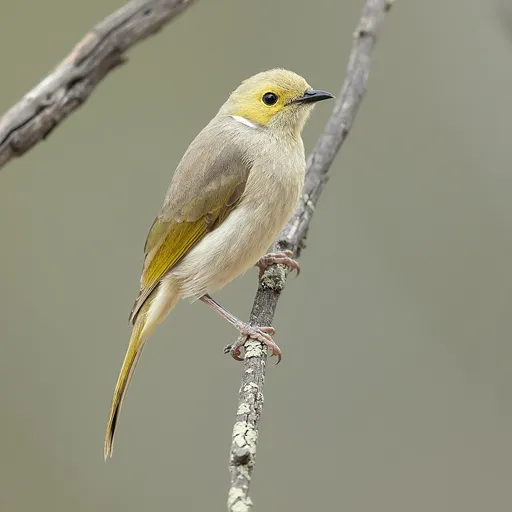
White-plumed Honeyeater
Ptilotula penicillata
Least Concern
Listen
XC492324 · Peter Russell · Cooya Pooya, Shire of Roebourne, Western Australia, Australia · CC BY-SA 4.0
Overview
The Ptilotula penicillata, formerly known as Lichenostomus penicillatus, is a medium-sized passerine bird of the honeyeater family endemic to mainland Australia. It is one of the most common honeyeaters in urban areas throughout much of the country and is classified as Least Concern on the IUCN Red List.
Identification
- Primarily olive-grey body with a yellow face and yellowish-olive feathers on the back, featuring distinctive white distal neck-plumes from which it derives its name.
- Slightly down-curved bill with breeding adults possessing a black bill, while non-breeding adults have a browner bill with yellow gape.
- Wings are mostly brown with olive to yellow-olive edges, and underwing coverts are white.
- Song varies by locality but includes a sharp, shrill descending chip, whistles, and twittering, with the species tending to be most vocal in July and August in the south.
Habitat
This arboreal species prefers open sclerophyll woodlands and riparian areas, showing a very strong association with River Red Gums and other water sources such as wetlands and creeks. Its range covers mainland Australia, widely distributed throughout south-eastern regions, central Australia, and parts of western Queensland, the Northern Territory, and Western Australia, while it is absent from Tasmania and sparsely vegetated arid areas.
Diet
The diet consists mainly of nectar, insects and their products such as honeydew and lerp, manna, and fruit, with nectar, lerp, and manna forming a more significant energy source than insects. Foraging is typically done by gleaning leaf surfaces in tree crowns, saplings, or shrubs using a tongue with brush-like filaments to mop up nectar, though the bird occasionally hawks insects on the wing or forages on the ground.
Did you know?
In xeric habitats, a white-plumed honeyeater may need to feed on 500–1000 berries in a five-hour period to obtain sufficient water and meet caloric requirements.
Sources
- Wikipedia · CC BY-SA 4.0
- Wikidata · CC0 1.0