
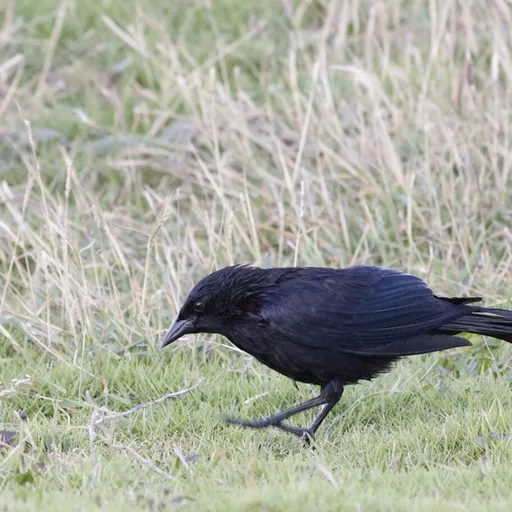
Cuban Blackbird
Ptiloxena atroviolacea
Least Concern
Overview
The Cuban blackbird (Ptiloxena atroviolacea) is a species of bird in the family Icteridae, endemic to Cuba. It is classified as Least Concern on the IUCN Red List, with a population believed to be stable and widespread.
Identification
- Adults are entirely black with bluish and purple iridescence on the upperparts and a greenish sheen on the wings and uppertail coverts.
- Females share the black plumage but exhibit less iridescence compared to males.
- Measures 25 to 28 cm in length with a dark brown iris, black bill, and black legs and feet.
- Produces a vast variety of calls, including loud, repetitive 'tí-o' notes with a metallic tone.
Habitat
Found throughout the main island of Cuba and on a few small cays off its northern and southern shores, though absent from most cays. It inhabits virtually all forested landscapes, as well as croplands, gardens, and urban or suburban areas, ranging in elevation from sea level to about 950 m.
Diet
Omnivorous, feeding on insects, other arthropods, small vertebrates, seeds, fruit, and nectar. It primarily forages on the ground but also feeds in all parts of trees up to the canopy, often in pairs or family groups.
Did you know?
The Cuban blackbird has been observed picking ticks and other parasites from farm animals.
Sources
- Wikipedia · CC BY-SA 4.0
- Wikidata · CC0 1.0