
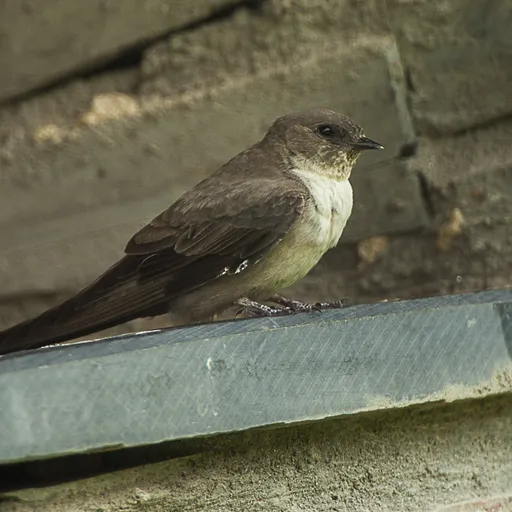
Eurasian Crag Martin
Ptyonoprogne rupestris
Least Concern
Listen
XC580313 · Pascal Christe · Binn, Langthal (near Binn), Goms, Wallis, Switzerland · CC BY-SA 4.0
Overview
The Eurasian crag martin (Ptyonoprogne rupestris) is a small passerine bird in the swallow family, characterised by its ash-brown upperparts and distinctive tail. It is a resident of mountainous regions across the Palearctic, though some northern populations migrate to winter in Africa, the Middle East, or India. Listed as Least Concern on the IUCN Red List, the species benefits from an expanding range facilitated by its increasing use of man-made structures for nesting.
Identification
- Size and shape: Approximately 13–15 cm long with a 32–34.5 cm wingspan, possessing a broader body, wings, and tail than other European swallows.
- Plumage: Ash-brown upperparts with paler underparts; the short, square tail features large white patches on most feathers, which are significantly larger than those of related species.
- Details: Small black bill, brownish-pink legs, and brown eyes; underwing and undertail coverts are blackish.
- Flight: Appears relatively slow with rapid wing beats interspersed with flat-winged glides, often flying high to display white tail spots.
Habitat
Breeds on dry, warm, and sheltered cliffs in mountainous areas with crags and gorges, typically at altitudes of 2,000–2,700 m but up to 5,000 m in Central Asia. Its range spans from Iberia and northwestern Africa through southern Europe and the Himalayas to parts of China, though it is a rare vagrant in northern Europe such as the UK and Sweden. Many European birds are resident, but northern and Asian populations migrate to warmer regions for winter.
Diet
Feeds primarily on a wide variety of insects caught in flight, including flies, ants, beetles, and aquatic species such as stoneflies and pond skaters. Forages near cliff faces, over streams, or in alpine meadows, exploiting standing waves in the airflow that concentrate insects near vertical surfaces. Occasionally takes prey items directly from rocks, the ground, or water surfaces.
Did you know?
Eurasian crag martins show extremely high fidelity to specific winter roosting caves, with over a 90% chance of being recaptured at the same location where they were first caught. The largest known roost, located at the Gorham's Cave Complex in Gibraltar, can house up to 12,000 birds during a single winter season.
Sources
- Wikipedia · CC BY-SA 4.0
- Wikidata · CC0 1.0