
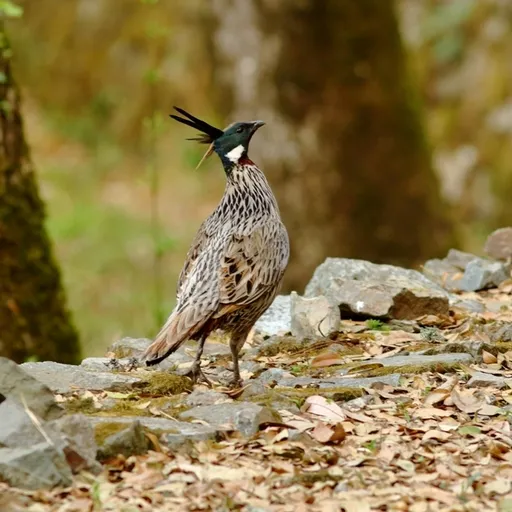
Koklass Pheasant
Pucrasia macrolopha
Least Concern
Overview
The koklass pheasant (Pucrasia macrolopha) is a monotypic species of gamebird that is distantly related to pheasants but most closely related to grouse and turkeys. It is a medium-sized, elusive bird that belongs to the family Phasianidae.
Identification
- Males possess silver-grey upper parts streaked with velvety-black, a distinctive black head, a chestnut breast, and prominent white patches on the sides of the neck.
- Females and juveniles feature pale brown upper parts, lacking the bold markings of the male, though both sexes have elongated tails tipped with pale feathers.
- The bird is relatively large, with body lengths ranging from 58 to 64 cm for males and 18 to 22 cm for females, though it often skulks under bushes making direct sightings difficult.
- During the breeding season and in autumn, the species reveals its presence through loud chorused calls.
Habitat
Confined to high-altitude forests, the koklass pheasant ranges from Afghanistan to central Nepal, and in northeastern Tibet to northern and eastern China. Like the western tragopan, it does not extend its range above the tree line, preferring to roost in trees or under rock overhangs at night.
Diet
The species is largely vegetarian for much of the year, consuming pine nuts, pine shoots, bamboo shoots, and seeds. During warmer nesting months, it becomes highly insectivorous, feeding almost exclusively on ants, as well as catkins, pollen, and fruit.
Did you know?
The names koklass and pucrasia are onomatopoeic derivations of the bird's territorial call. Despite being a pheasant, it is closely related to progenitive grouse from the Miocene and is one of the few gamebirds that regularly flies uphill and can sustain flights of many miles.
Sources
- Wikipedia · CC BY-SA 4.0
- Wikidata · CC0 1.0