
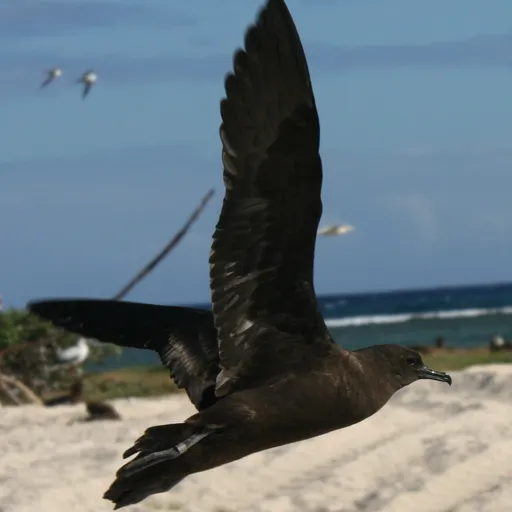
Puffinus nativitatis
Puffinus nativitatis
Overview
The Christmas shearwater, also known as the ʻaoʻū, is a medium-sized shearwater of the tropical Central Pacific and a member of an ancient lineage of Puffinus species. It is a poorly known bird due to its remote nesting habits and limited study at sea, with the Galápagos shearwater as its closest living relative.
Identification
- Plumage: Dark and slender, generally blackish-grey with a rusty-brown tinge, slightly paler underneath, featuring small white edging under the chin and pale fringes to the upperwing coverts.
- Size: Approximately 36 cm in length with a wingspan of around 75 cm and a weight of roughly 350 g.
- Features: Possesses brown-grey feet, a dark bill, and dark eyes; the short tail typically tapers to a point in flight, enhanced by feet protruding beyond the tail-tip.
- Flight: Often flies in a leisurely manner with slow wingbeats, which can lead to confusion with petrels, though the bulbous head and thin, long bill distinguish it from similar species.
Habitat
Nesting occurs on remote sandy islands in the Central Pacific, including the Northwestern Hawaiian Islands, Tuamotu, Marshall Islands, Kiritimati, and Sala-y-Gómez, typically on the surface under dense cover or rock outcroppings. Outside the breeding season, the species ranges across the Pacific, from the coasts of Mexico and Guatemala in the east to the Bonin Islands in the west, though it is rare further south.
Diet
Feeds at sea predominantly on squid, flying fish, and goatfish. Being highly pelagic, it depends on predatory fish such as tuna to drive prey to the surface for foraging.
Did you know?
This species is named after Kiritimati, also known as Christmas Island, where it was first described by Thomas Hale Streets in 1877.