
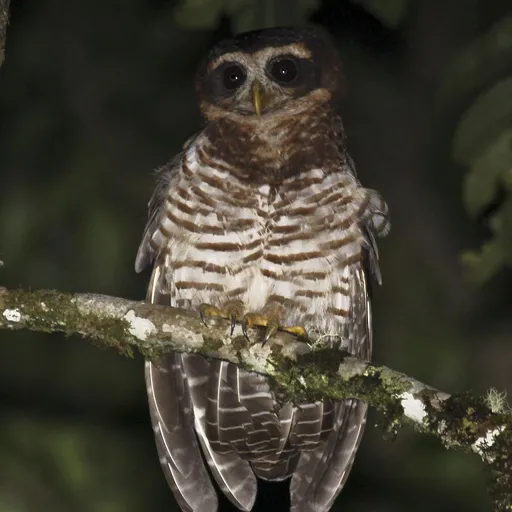
Band-bellied Owl
Pulsatrix melanota
Least Concern
Listen
XC572981 · Elvis felipe quintero · Guamal, Meta, Colombia · CC BY-SA 4.0
Overview
The band-bellied owl (Pulsatrix melanota) is a fairly large owl in the family Strigidae. It is distributed across the eastern slopes of the Andes in Bolivia, Colombia, Ecuador, and Peru. The species is assessed as being of Least Concern by the IUCN, although it remains poorly studied.
Identification
- Fairly large owl, 44–48 cm long, with dark chocolate brown upperparts and scattered buffy-white spots.
- Dark brown facial disk with distinct white 'brows' over dark reddish brown eyes.
- Tail is dark brown with thin white bars; upper breast is reddish brown with buff barring, and lower underparts are white to creamy with reddish brown barring.
- Vocalisations are poorly known but include a short, deep trill followed by a fast burst of popping notes, as well as deep, muffled hoots; the sexes perform duets.
Habitat
Primarily inhabits the interior of humid montane forest and foothill rainforest, ranging in elevation from 650 to 2,200 m. It is also found on forest edges and in clearings with scattered trees. The nominate subspecies occurs from central Colombia south through Ecuador and Peru, while P. m. philoscia extends to west-central Bolivia.
Diet
The band-bellied owl is nocturnal, and its diet, though poorly studied, is known to include large insects. It is presumed to nest in natural tree cavities, although its breeding phenology is not well documented.
Did you know?
Despite its appearance and scientific distinction, the band-bellied owl may form a superspecies with the tawny-browed owl (Pulsatrix koeniswaldiana), although the two are distinguished by different morphology and vocalisations.
Sources
- Wikipedia · CC BY-SA 4.0
- Wikidata · CC0 1.0