
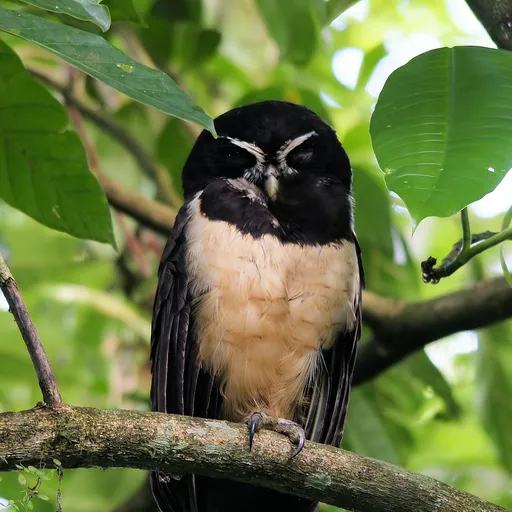
Spectacled Owl
Pulsatrix perspicillata
Least Concern
Listen
XC212537 · Cristian Eric Miranda · Bosque de Cinquera, El Salvador · CC BY-SA 4.0
Overview
The spectacled owl (Pulsatrix perspicillata), also known as the Murucututu, is a large tropical owl native to the neotropics. It is classified as a Least Concern species by the IUCN due to its extensive distribution and stable populations.
Identification
- Ranges from 41 to 52.3 cm in length, with females significantly heavier than males, reaching up to 1,250 g.
- Distinctive blackish-brown upperparts and head contrast with white facial markings and whitish to yellowish-ochre underparts.
- Features yellow eyes, the only Pulsatrix owl with this eye color, and a pale beak.
- Juveniles are unmistakable, appearing completely white except for a chocolate-brown facial disc.
Habitat
Primarily inhabits dense, old-growth tropical rainforests across a range from southern Mexico and Trinidad through Central America to South America. It may also utilise secondary habitats such as forest edges, dry forests, and subtropical montane cloud forests at lower elevations.
Diet
A solitary nocturnal hunter that typically perches on branches to scan for prey, dropping to pounce. It eats a wide array of mammals, including rodents, bats, and small monkeys, as well as invertebrates, frogs, and medium-sized birds. Prey can be significantly heavier than the owl, with reported kills of agoutis and sloths weighing up to four times its own mass.
Did you know?
The species is known locally in Brazil as the 'knocking owl' because its primary call consists of guttural knocking or tapping sounds that are similar to the pattern of a great spotted woodpecker. It is generally the largest and most dominant owl in its range, with larger species like the great horned owl rarely venturing into true rainforest habitats.
Sources
- Wikipedia · CC BY-SA 4.0
- Wikidata · CC0 1.0