
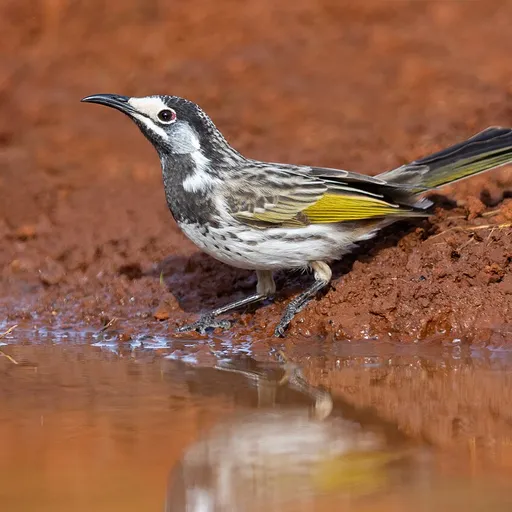
White-fronted Honeyeater
Purnella albifrons
Least Concern
Listen
XC1017128 · Rob Nicholson · Hugh, MacDonnell Region, Northern Territory, Australia · CC BY 4.0
Overview
The white-fronted honeyeater (Purnella albifrons) is a medium-sized bird species endemic to Australia. It is primarily distributed throughout arid and semi-arid landscapes and is currently classified as 'least concern' on the IUCN Red List.
Identification
- Distinct colouring features a white face and a black or brown upper chest marked with white speckles.
- Brown wings display yellow panels.
- The bird is medium-sized.
Habitat
Mainly distributed throughout arid and semi-arid landscapes, the species is secure in the majority of States and Territories in mainland Australia, including South Australia, Victoria, New South Wales, Queensland, the Northern Territory, and Western Australia. It is not found in Tasmania due to geographical distance and landscape composition. The species regularly frequents tall shrub species, such as Eremophila shrubs and flowering mallee plants.
Diet
Primarily consuming nectar from flowers, the white-fronted honeyeater may also eat seeds, plant matter, and insects when nectar is not available or in minimal supply. This dietary variation allows the bird to adapt to different environments and survive in arid areas.
Did you know?
White-fronted honeyeaters breed in small colonies to ensure that individuals can warn neighbours of potential predators when they are most vulnerable. Females construct cup-like nests from grasses, spider webs, roots, bark, and plant stems, which are then lined with wool, cotton threads, fur, and plant material for warmth and comfort.
Sources
- Wikipedia · CC BY-SA 4.0
- Wikidata · CC0 1.0