
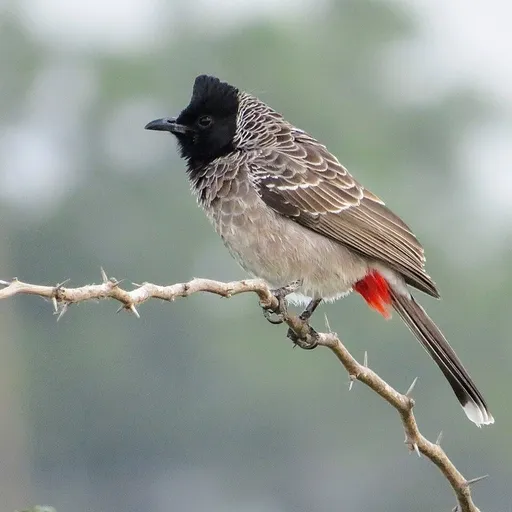
Red-vented Bulbul
Pycnonotus cafer
Least Concern
Listen
XC671492 · Vihansith Kulatunga · Palaiyoothu, Trincomalee, Eastern Province, Sri Lanka · CC BY-SA 4.0
Overview
The red-vented bulbul (Pycnonotus cafer) is a member of the bulbul family found as a resident breeder across South Asia and extending east to Burma. It has established itself as an introduced species in various other parts of the world and is included in the list of the world's 100 worst invasive alien species.
Identification
- Approximately 20 cm in length with a short crest that gives the head a squarish appearance.
- Dark brown body with a scaly pattern and a darker or black head, featuring a white rump and a red vent.
- Long black tail tipped in white, with Himalayan races showing a more prominent crest and increased streaking on the underside.
- Typical call transcribed as ginger beer, accompanied by sharp single notes sounding like pick.
Habitat
This species inhabits dry scrub, open forest, plains, and cultivated lands, rarely occurring in mature forests within its native range. It prefers dry lowland habitats and has been successfully introduced to regions such as Fiji, Tonga, Samoa, and the USA, although a successful extermination campaign occurred in New Zealand in 1955.
Diet
Red-vented bulbuls feed on fruits, flower petals, nectar, insects, and occasionally house geckos or leaves. They serve as important dispersers of seeds for plants such as Carissa spinarum and invasive species like Lantana camara and Miconia calvescens.
Did you know?
This bird was among the first animals other than humans found to be incapable of synthesizing vitamin C. It was also historically kept in India as a cage pet and used for fighting, where birds would seize the red feathers of their opponents.
Sources
- Wikipedia · CC BY-SA 4.0
- Wikidata · CC0 1.0