
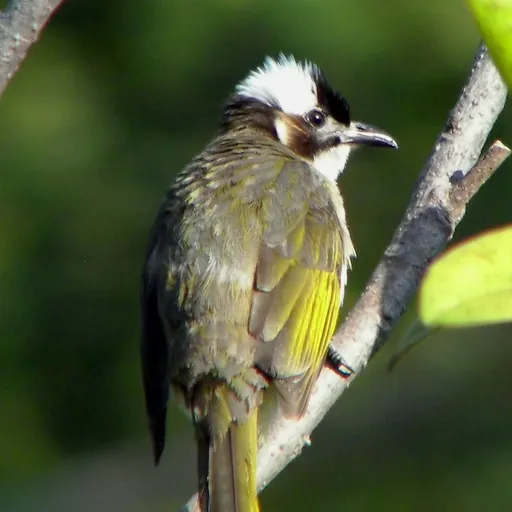
Light-vented Bulbul
Pycnonotus sinensis
Least Concern
Overview
The light-vented bulbul, also known as the Chinese bulbul, is a common species of songbird in the family Pycnonotidae found across Asia. It thrives in lightly wooded habitats and is frequently observed in towns, suburbs, and urban parks within its range.
Identification
- Approximately 19 cm in length with a black crown and moustachial stripe, contrasted by white patches on the nape and sides of the head.
- Upperparts are greyish-brown mixed with olive, while wings and tail are brown fringed with bright olive.
- Underparts are whitish with a distinct pale brown breastband.
- Noisy and vocal, producing bright and variable songs that sound like 'cha-ko-lee...cha-ko-lee'.
Habitat
This species favors lightly wooded areas, cultivated land, and shrubland, and is also common in urban environments such as towns, suburbs, and parks. Its range includes central and eastern China, South-East Asia, Taiwan, and the Ryukyu Islands. It is a widespread resident of these regions.
Did you know?
Despite its name suggesting a specific geographic origin, the species was originally described by Johann Friedrich Gmelin as a flycatcher in the genus Muscicapa before being reclassified into Pycnonotus in 1836. It was first formally described based on a specimen from Guangzhou, referred to in earlier literature as 'Le gobe-mouches verdâtre de la Chine'.
Sources
- Wikipedia · CC BY-SA 4.0
- Wikidata · CC0 1.0