
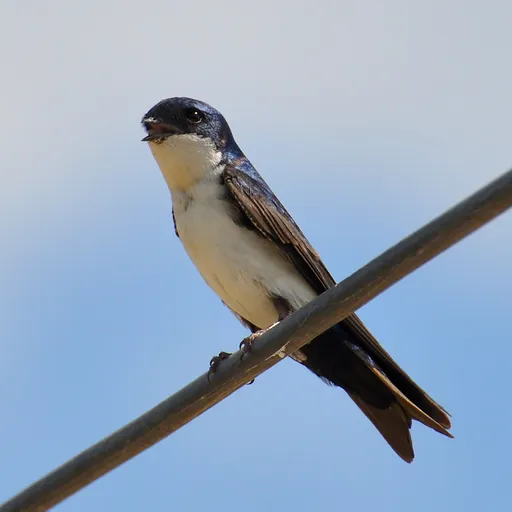
Blue-and-white Swallow
Pygochelidon cyanoleuca
Least Concern
Listen
XC242901 · Niels Krabbe · Carchi: Loma Laurel, Ecuador · CC BY-SA 4.0
Overview
The blue-and-white swallow is a small passerine bird found in open areas across South and Central America, classified as Least Concern by the IUCN. It is a common and popular species that has benefited from deforestation and human settlement, which have increased its suitable habitat.
Identification
- Adults feature dark blue upperparts and white underparts, with blackish underwings and the undersurface of a short forked tail.
- The juvenile appears brown above and buff-tinted below with a less forked tail.
- The call is described as a buzzing dzzzhreeee.
- Typical flight is fluttery, and the bird frequently perches on wires or branches.
Habitat
This species inhabits open areas such as villages, towns, farms, and forest clearings, where it is often found in small flocks outside the breeding season. While it is a highland bird in Central America, it ranges from lowlands to 4,000 m in other parts of its distribution, breeding from Nicaragua south throughout South America except in deserts and the Amazon Basin.
Diet
The blue-and-white swallow subsists primarily on a diet of insects caught in the air. It has been observed gathering where termites swarm to feed.
Did you know?
The bird's shallow straw nest is constructed in a wide variety of natural and man-made cavities, including tree holes, rock crevices, and bridges.
Sources
- Wikipedia · CC BY-SA 4.0
- Wikidata · CC0 1.0