
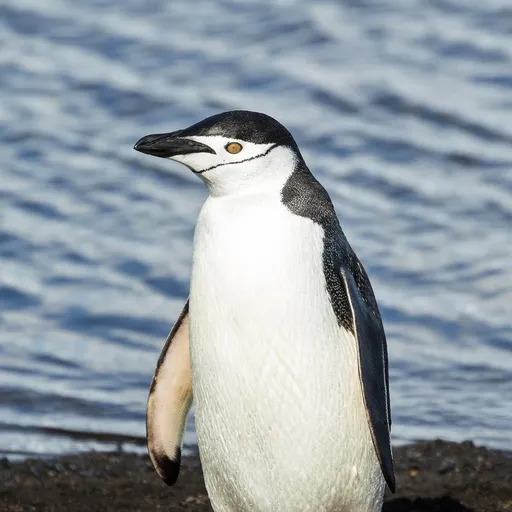
Chinstrap Penguin
Pygoscelis antarcticus
Least Concern
Listen
XC953122 · steve · Cámara Base, Antarctica · CC BY-SA 4.0
Overview
The chinstrap penguin (Pygoscelis antarcticus) is a species inhabiting various islands and shores in the Southern Pacific and the Antarctic Oceans. Its name stems from the narrow black band under its head, which makes it appear to wear a black helmet. The species is also known as the ringed, bearded, or stonecracker penguin.
Identification
- A narrow black band under the head creates the appearance of a black helmet.
- Flippers are black with a white edge, while the inner sides are white.
- The face, chin, and throat are white, featuring reddish-brown eyes and a short black bill.
- Strong, pink webbed feet and legs contribute to a distinct waddle when walking on land.
Habitat
Chinstrap penguins have a circumpolar distribution, breeding in Antarctica, Argentina, Bouvet Island, Chile, the French Southern Territories, and South Georgia and the South Sandwich Islands. Vagrant individuals have occasionally been found in New Zealand, Saint Helena, Tristan da Cunha, and South Africa.
Diet
Their diet consists of small fish, krill, shrimp, and squid, which they obtain by swimming up to 80 km offshore each day. Tightly packed feathers provide a waterproof coat for freezing waters, while thick blubber and intricate blood vessels in the flippers and legs help retain heat.
Did you know?
Chinstrap penguins are generally considered the most aggressive and ill-tempered species of penguin, often attacking anything approaching their nesting grounds that is not a chinstrap penguin, including humans and other penguin species. In 2004, two male chinstraps in New York City formed a pair bond and successfully raised a chick after taking turns incubating an egg.
Sources
- Wikipedia · CC BY-SA 4.0
- Wikidata · CC0 1.0