
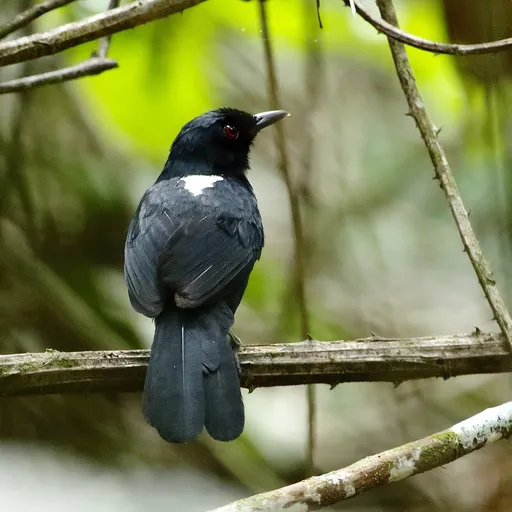
East Amazonian Fire-eye
Pyriglena leuconota
Least Concern
Overview
The East Amazonian fire-eye (Pyriglena leuconota) is an insectivorous bird endemic to Brazil and a member of the family Thamnophilidae, known as the typical antbirds. It is classified as Least Concern by the IUCN, although its taxonomy remains unsettled with some authorities treating it as part of the white-backed fire-eye complex.
Identification
- Both sexes possess bright red irises.
- Males are primarily glossy black with a partially hidden white patch between the scapulars and blackish-grey underwing coverts.
- Females of the nominate subspecies have dark reddish-brown upperparts, a brownish-grey face, buff throat, and dark yellowish-brown underparts, all featuring a partially hidden white interscapular patch.
- The song consists of a rapid, slightly rising then descending series of very high, staccato 'weet---' notes lasting about two seconds, accompanied by a nasal 'thew-tjew' call.
Habitat
This species inhabits dense understorey vegetation in lowland and foothill evergreen forests, typically at the edges of primary forest, in mature secondary forest, and in clearings caused by fallen trees. It has a disjunct distribution in Brazil, found south of the Amazon in eastern Pará and northern Maranhão, and separately in eastern Pernambuco and Alagoas, reaching elevations up to 950 m.
Diet
Diet includes a wide variety of insects such as orthopterans, beetles, ants, wasps, and moths, along with other arthropods like spiders and centipedes, and small lizards up to 11 cm long. They forage singly, in pairs, or in family groups, hopping through dense vegetation mostly on the ground and within 3 m above it, using techniques such as gleaning, reaching, jumping, lunging, and tossing leaf litter. They regularly follow army ant swarms to capture disturbed prey, dominating such groups within their own territory but remaining subordinate to obligate ant-following species.
Did you know?
The nest is constructed as an 'oven' made of dried leaves and twigs mixed with club mosses and grass roots, with the male doing most of the building. While both parents provision the nestlings, they appear to each provision one young.
Sources
- Wikipedia · CC BY-SA 4.0
- Wikidata · CC0 1.0