
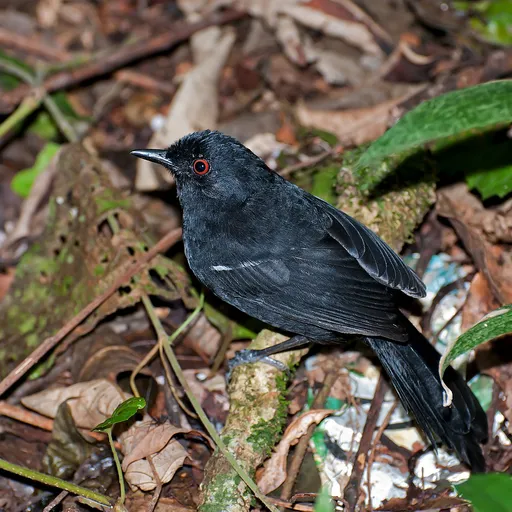
White-shouldered Fire-eye
Pyriglena leucoptera
Least Concern
Overview
The white-shouldered fire-eye (Pyriglena leucoptera) is a species of bird in the family Thamnophilidae, commonly known as typical antbirds. It is a year-round resident found in parts of South America, specifically Argentina, Brazil, and Paraguay, and is currently assessed as a species of Least Concern by the IUCN.
Identification
- Males are predominantly glossy black with a white patch between the scapulars, white lesser wing coverts, and white-tipped median and greater wing coverts.
- Females possess yellowish brown to chestnut crown, upperparts, and wings, lacking the interscapular patch seen in males.
- Adults of both sexes have bright red irises, olive-tinged gray faces with black lores, and white chins and throats.
- The species measures 16 to 18 cm in length and weighs between 25 and 34 g.
- The male song consists of a slow, short series of about five descending, fluted notes, while females sing a similar song that descends more.
Habitat
This bird inhabits dense understorey vegetation in lowland evergreen forest, primarily along the edges of primary forest, in mature secondary forest, and in clearings created by fallen trees. It favors areas with dense thickets, vine tangles, and large stands of bamboo while shunning sunlit areas with little undergrowth. Its range spans eastern Brazil from eastern Bahia and southwestern Minas Gerais south to Mato Grosso do Sul and extreme northern Rio Grande do Sul, eastern Paraguay from Canindeyú to Itapúa, and extreme northeastern Argentina's Misiones Province, occurring at elevations from near sea level to about 1,300 m.
Diet
The white-shouldered fire-eye feeds on insects such as cockroaches, beetles, and ants, as well as other arthropods like spiders and small vertebrates such as geckos. It typically forages singly, in pairs, or in family groups within dense vegetation, mostly on the ground or up to 3 m above it, though it can forage as high as 10 m. It captures prey by gleaning, reaching, jumping, lunging from perches, searching leaf litter, and frequently following army ant swarms to catch disturbed prey.
Did you know?
The breeding season spans from September to December, during which the bird constructs a ball-shaped nest on the ground or a low stump using leaves, leaf petioles, and bamboo sheaths, featuring a short upward-facing tunnel entrance. Both parents are involved in incubating the clutch of two white eggs marked with rufous and chestnut patterns.
Sources
- Wikipedia · CC BY-SA 4.0
- Wikidata · CC0 1.0