
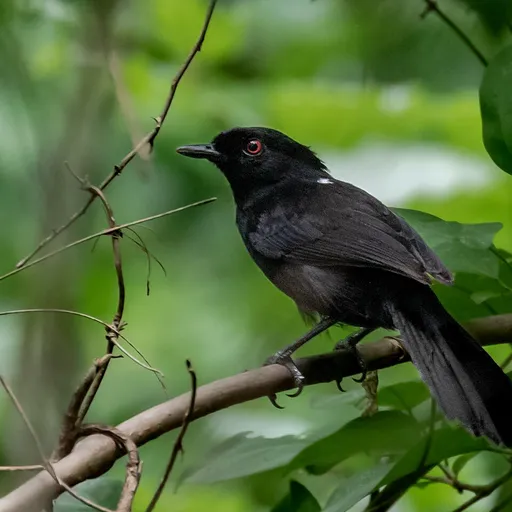
Western Fire-eye
Pyriglena maura
Listen
XC251446 · Niels Krabbe · Napo: Napo Galeras, Ecuador · CC BY-SA 4.0
Overview
The western fire-eye (Pyriglena maura) is an insectivorous bird belonging to the subfamily Thamnophilinae within the family of typical antbirds. It is distributed across parts of South America, including Bolivia, Brazil, Colombia, Ecuador, Paraguay, and Peru.
Identification
- Males are mostly glossy black with a partially hidden white patch between the scapulars and blackish-grey underwing coverts.
- Both sexes possess bright red irises.
- Females exhibit varying plumage by subspecies, ranging from light rufescent brown to sooty black, often featuring a white supercilium and a black eye line.
- The song of males is a medium-length series of evenly paced short whistles that rise and fall slightly in pitch, sometimes described as "peer" notes in Ecuador.
Habitat
Primarily inhabits dense understorey vegetation in lowland and foothill evergreen forest, often at the edges of primary forest, in mature secondary forest, or in clearings. It also occupies gallery and deciduous forest in certain areas. Elevations vary significantly by region, ranging from near sea level to 2,500 m.
Diet
Feeds on a wide variety of insects, including orthopterans, beetles, ants, wasps, and moths, as well as other arthropods like spiders and centipedes, and small lizards up to 11 cm long. It forages singly, in pairs, or in family groups, hopping between short feeding stops on the ground and within 3 m of it, capturing prey by gleaning, reaching, jumping, or tossing aside leaf litter. It regularly follows army ant swarms to capture disturbed prey.
Did you know?
The western fire-eye constructs a ground-level "oven" nest hidden among vegetation, with the male performing most of the construction work. Despite limited data, the species is considered more capable than many forest birds of persisting in older second growth.