
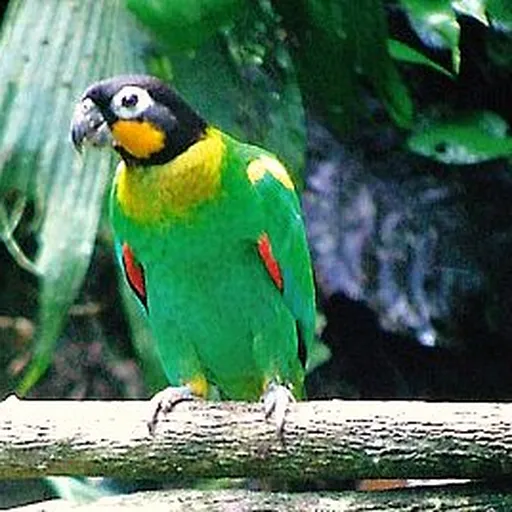
Orange-cheeked Parrot
Pyrilia barrabandi
Least Concern
Overview
The orange-cheeked parrot, also known as Barraband's parrot, is a species of parrot in the family Psittacidae. It was formerly placed in the genus Pionopsitta, which is now monotypic, and is classified as Least Concern on the IUCN Red List despite threats from habitat loss.
Identification
- Adults have a black head with orange to yellow cheeks and a distinctive white eye-ring surrounding a brown eye.
- The throat and breast are olive, while the thighs, bend of the wing, and lesser wing coverts range from yellow to orange, and the carpal edge and underwing coverts are orange to red.
- The tips of the tail and wing feathers are blue, and the beak is grey to black.
- Juveniles possess a brown crown and olive forehead, nape, cheeks, and chin, with green wings featuring scattered yellow.
Habitat
This species inhabits the Amazonian Andes, specifically in humid lowland terra firme forests and occasionally in várzea stands at elevations up to 400 m. Its range covers northwestern, southwestern, and south-central parts of the Amazon Basin in South America, including northwestern Brazil, western Ecuador and Peru, southern Venezuela, and Colombia.
Diet
The orange-cheeked parrot feeds on seeds, fruit, and wasp larvae found in galls, foraging high in the canopy or just below it. It also visits clay banks to consume antacid-like soil that neutralises acids found in its food.
Did you know?
The binomial name of this bird commemorates the French painter Jacques Barraband. It is occasionally kept as a pet in Brazil.
Sources
- Wikipedia · CC BY-SA 4.0
- Wikidata · CC0 1.0