
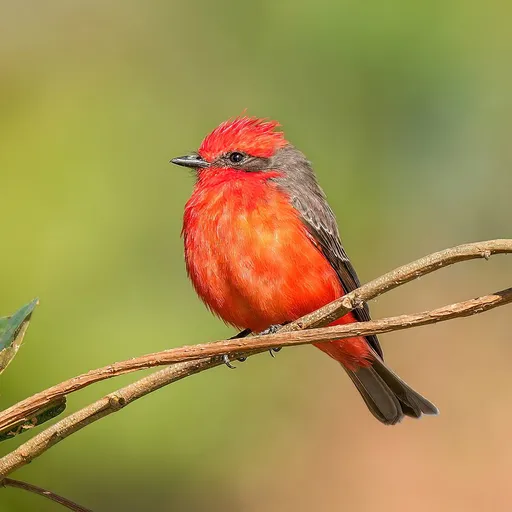
Scarlet Flycatcher
Pyrocephalus rubinus
Least Concern
Overview
The scarlet flycatcher (Pyrocephalus rubinus), also known as the austral vermilion flycatcher, is a small passerine bird in the tyrant flycatcher family. It is currently classified as a full species by the International Ornithological Committee, though some other authorities still consider it a subspecies of the vermilion flycatcher.
Identification
- Approximately 14 cm long with a weight of 12 to 15 g.
- Adult males feature an intense poppy red forehead and crown, a dark grayish brown facial mask, and blackish upperparts.
- Adult females are predominantly grayish brown with a whitish supercilium and dull white underparts streaked with grayish brown.
- Song consists of an extra-high tic-tic-psiieh, while the call is an extra-high psi.
Habitat
Found in southeastern Colombia, central and southern Brazil, eastern Ecuador, eastern Peru, eastern Bolivia, Argentina, Paraguay, and Uruguay. It inhabits semi-open to open landscapes, including open woodland, the edges of denser woodlands, pastures with scattered trees, and agricultural areas.
Diet
The bird feeds mostly on insects caught in mid-air by hawking from a perch, and also from the ground.
Did you know?
The species was first described in 1779 by the French polymath Georges-Louis Leclerc, Comte de Buffon, and was illustrated by François-Nicolas Martinet, but neither included a scientific name in the original publication.
Sources
- Wikipedia · CC BY-SA 4.0
- Wikidata · CC0 1.0