
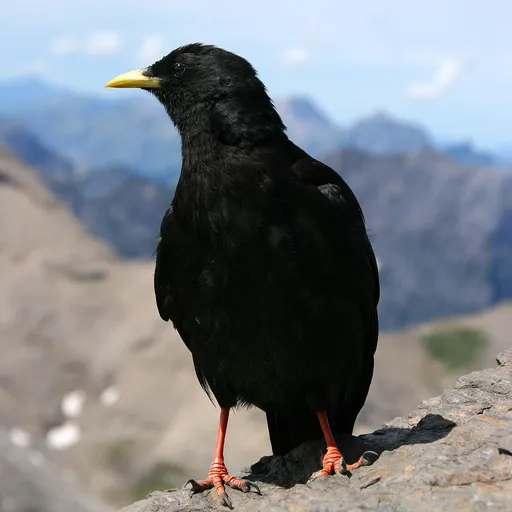
Alpine Chough
Pyrrhocorax graculus
Least Concern
Listen
XC496675 · Marie-Lan Taÿ Pamart · Cogne, Valle d'Aosta, Valle d'Aosta, Italy · CC BY-SA 4.0
Overview
The Alpine chough, also known as the yellow-billed chough, is a member of the crow family and one of only two species in the genus Pyrrhocorax. It is a non-migratory resident of high mountain ranges across southern Europe, North Africa, and Central Asia, where it may nest at a higher altitude than any other bird.
Identification
- Plumage: Glossy black overall, with sexes identical in appearance though males are slightly larger; juveniles appear duller with brownish legs and dull yellow bills.
- Bill and Legs: Distinguished by a short yellow bill and red legs, setting it apart from the red-billed chough which has a long red bill.
- Flight: Characterised by a buoyant, acrobatic style with widely spread flight feathers, loose deep wing beats, and a longer, less square-ended tail compared to its relative.
- Vocalisation: Produces a rippling preep and whistled sweeeooo call, along with a rolling churr alarm call, which are distinct from the crow-like chee-ow of the jackdaw or red-billed chough.
Habitat
This high-altitude species typically breeds between 1,260 and 5,000 metres, favouring inaccessible rock faces where it nests in cavities, fissures, or abandoned buildings. It forages in open alpine meadows, scree slopes, and short-grazed grasslands, often congregating around ski resorts and tourist facilities in winter. Its range spans from Spain eastwards through the Alps to the Himalayas, including isolated populations in Morocco, Corsica, and Crete.
Diet
The Alpine chough forages primarily in flocks, consuming invertebrates such as beetles, snails, and grasshoppers in summer, while shifting to fruits like berries, rose hips, and domesticated crops in winter. It supplements its diet with human food at tourist sites and is observed to practice coprophagy in winter, consuming its own and other birds' faeces to obtain nutrients when snow cover limits alternative food sources. Food is often cached in cracks and fissures, concealed with pebbles.
Did you know?
The species may nest at a higher altitude than any other bird, having been recorded at 6,500 metres and observed following mountaineers on Mount Everest at 8,200 metres. Its eggs possess adaptations for the thin high-altitude atmosphere, featuring fewer pores to reduce water loss and haemoglobin with a high affinity for oxygen to improve uptake.
Sources
- Wikipedia · CC BY-SA 4.0
- Wikidata · CC0 1.0