
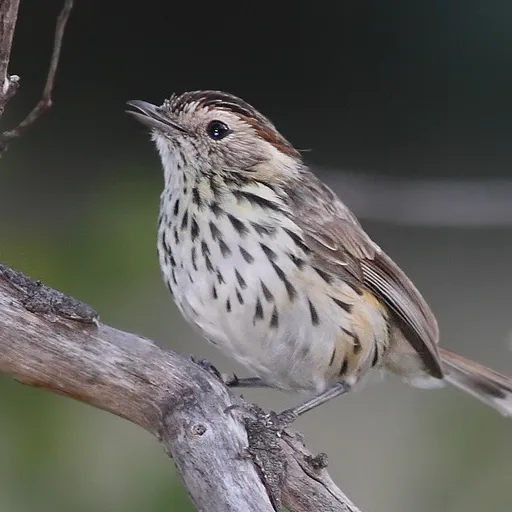
Speckled Warbler
Pyrrholaemus sagittatus
Least Concern
Overview
The speckled warbler, Pyrrholaemus sagittatus, is a small, ground-dwelling bird in the family Acanthizidae endemic to eastern Australia. It is a monotypic species with no subspecies, currently classified as Least Concern on the IUCN Red List.
Identification
- Measures 11.5 to 12.5 cm in length with grey-brown upperparts featuring darker streaks and an off-white face streaked with buffy-brown.
- Underparts are yellowish-white and heavily streaked with black, while the tail is dark brown with a black subterminal band and white tips, usually held horizontally.
- Males have a black upper margin to the brow, whereas females possess a reddish-brown margin; both have brown eyes, dark grey-brown bills, and pinkish-brown legs.
- Produces a soft, mellow, and musical song interspersed with sharp whistles, and emits a distinctive whirring sound with its wings in flight.
Habitat
Found in southeastern Australia, the species inhabits open eucalypt woodland characterised by rocky gullies, tussocky grass, scattered logs, and sparse shrubbery. Its distribution is patchy across Queensland, New South Wales, the Australian Capital Territory, and Victoria.
Diet
Primarily insectivorous, this bird forages on the ground, often in mixed-species flocks, feeding on beetles, wasps, winged ants, moth and butterfly larvae, mantids, and grasshoppers. It occasionally consumes seeds as part of its diet.
Did you know?
The specific epithet sagittatus means 'shot with arrows' in Latin, referring to the bird's heavily streaked chest. It is also known by several other common names, including blood tit, chocolate-bird, and speckled jack.
Sources
- Wikipedia · CC BY-SA 4.0
- Wikidata · CC0 1.0