
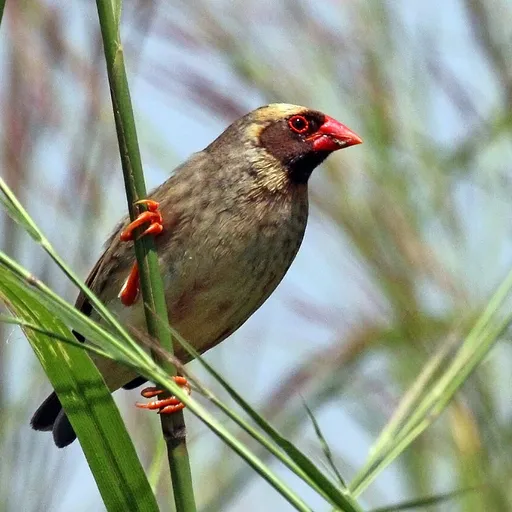
Red-billed Quelea
Quelea quelea
Least Concern
Overview
The red-billed quelea is a small, seasonally nomadic, sparrow-like bird of the weaver family, Ploceidae, native to sub-Saharan Africa. It is regarded as the most numerous undomesticated bird on earth, with post-breeding populations sometimes peaking at an estimated 1.5 billion individuals.
Identification
- Approximately 12 cm long with a heavy, cone-shaped bill that is raspberry red in males and yellow or orange in breeding females.
- Non-breeding plumage features light underparts, brown striped upper parts, and yellow-edged flight feathers.
- Breeding males display a black or white facial mask surrounded by a purplish, pinkish, rusty, or yellowish wash on the head and breast.
- Singing consists of short bursts of chatter followed by a warbling 'tweedle-toodle-tweedle' sound.
Habitat
Native to most of sub-Saharan Africa, this species inhabits tropical and subtropical semi-arid areas such as the Sahel and dry thornbush grasslands. It avoids forests, deserts, and colder high-altitude regions, typically residing below 1,500 m but occasionally reaching 3,000 m. The species is strictly dependent on access to water, generally staying within 30 km of the nearest body of water.
Diet
Primarily feeding on seeds of annual grasses, the red-billed quelea also causes extensive damage to cereal crops in agricultural areas. It forages in huge flocks of millions, with birds running out of food at the rear flying over the group to fresh feeding zones at the front, creating a rolling cloud effect. When local food sources are exhausted, the species moves to locations of recent rainfall and plentiful grass seed.
Did you know?
Because of its ability to cause extensive damage to crops, the species is sometimes called 'Africa's feathered locust'. Large control measures, including spraying avicides or detonating fire-bombs in enormous colonies at night, have been largely unsuccessful in limiting its population.
Sources
- Wikipedia · CC BY-SA 4.0
- Wikidata · CC0 1.0