
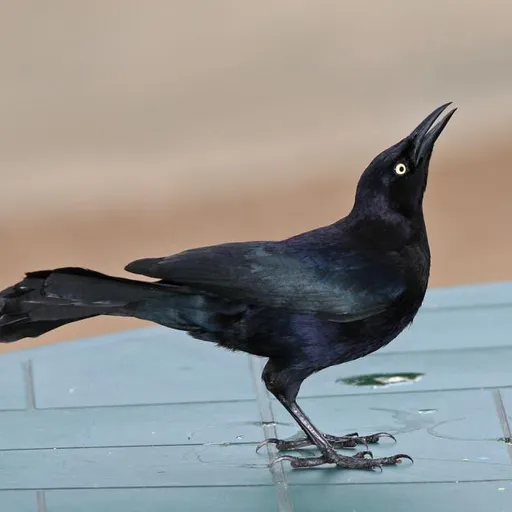
Carib Grackle
Quiscalus lugubris
Least Concern
Overview
The Carib grackle (Quiscalus lugubris) is a species of bird in the family Icteridae. It is distributed throughout the Lesser Antilles, across northern South America, and on several islands off South America's northern coast. The species is assessed as being of Least Concern by the IUCN.
Identification
- Males average 26 cm in length and possess a long keel-shaped ('V') tail, while females are smaller (about 22 cm) with shorter, flat tails.
- Adult males are completely black with a violet gloss that is more violet-blue on the wing coverts and greener on the flight feathers; females have dull dark brownish upperparts and lighter brownish underparts.
- Both sexes have yellow irises, black bills, and black legs and feet, though juvenile males are dark brown and juvenile females a warmer brown.
- Vocalisations vary by subspecies but generally include squeaky notes, whistles, and chucks; in Venezuela, the most common call is a loud, ringing, bouncy 'queek-queek-queek-queek'.
Habitat
The Carib grackle inhabits a variety of open landscapes including scrublands, open woodland, pastures, plantations, palm groves, parks, gardens, and suburban or urban areas including large cities. It is found at elevations below 500 m in Colombia, below 850 m in Venezuela, and below 300 m in Brazil.
Diet
This species is opportunistic and omnivorous, feeding on insects, other arthropods, small vertebrates like lizards, eggs, chicks, seeds, and fruits. It has also been observed catching fish, frogs, and bats on the wing. In human-inhabited areas, it forages for food scraps and has been known to enter restaurants.
Did you know?
In human-inhabited areas, Carib grackles become practically pensioners of people, with boisterous groups often congregating in plazas and residential areas.
Sources
- Wikipedia · CC BY-SA 4.0
- Wikidata · CC0 1.0