
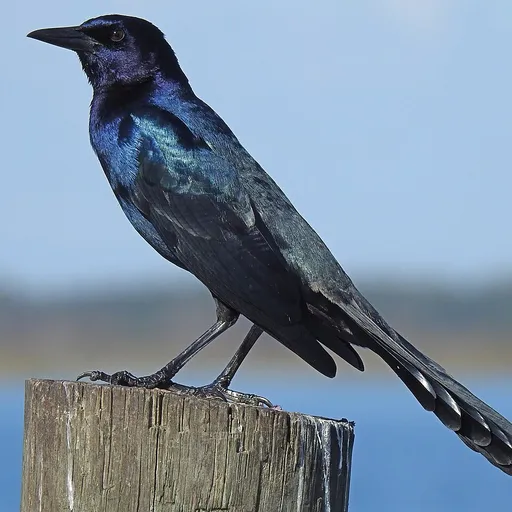
Boat-tailed Grackle
Quiscalus major
Least Concern
Overview
The boat-tailed grackle (Quiscalus major) is a passerine bird of the family Icteridae that serves as a permanent resident on the coasts of the Southeastern and Mid-Atlantic United States. Despite its restricted range, the species is classified as Least Concern on the IUCN Red List.
Identification
- Males measure 37–43 cm in length with entirely iridescent black plumage, a long dark bill, and a pale yellowish or brown iris.
- Females are significantly smaller, ranging from 26–33 cm, with tawny-brown bodies, darker wings and tail, and a shorter tail than males.
- The species possesses a distinct domed head shape and a long, keel-shaped tail.
- Song consists of a harsh jeeb accompanied by typical grackle-like chatters and squeaks, lacking the whistles and clucks heard in the great-tailed grackle.
Habitat
This species inhabits coastal saltwater marshes and ranges across the Florida peninsula, where it may form mixed colonies with least bitterns. Significant populations have established themselves in several United States Gulf Coast cities and towns, utilizing human activity for protection and scavenging.
Diet
As an omnivorous opportunist, the boat-tailed grackle forages on the ground, in shallow water, or within shrubs for a diet consisting of insects, crustaceans, minnows, frogs, eggs, berries, seeds, grain, and occasionally small birds. They are known to steal food from other birds, animals, and humans.
Did you know?
Although males defend harems of closely nesting females, genetic evidence indicates that only about a quarter of the young are actually fathered by the dominant male, as females frequently mate with other males away from the colony. Urban populations have adapted to use human trash bins, parking lots, and restaurant patios for foraging.
Sources
- Wikipedia · CC BY-SA 4.0
- Wikidata · CC0 1.0