
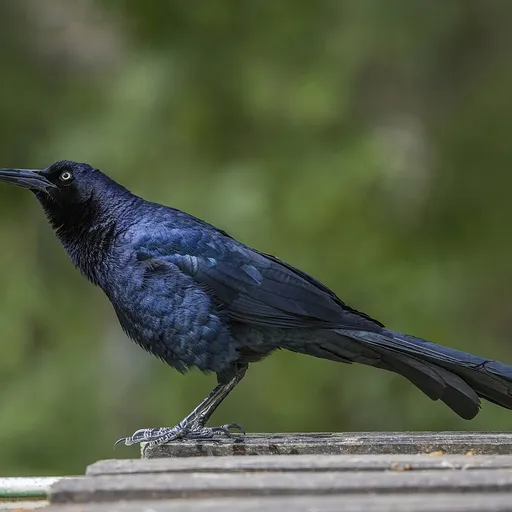
Great-tailed Grackle
Quiscalus mexicanus
Least Concern
Listen
XC1031260 · Gean Carlo Valdés · Islas secas, Panama · CC0 1.0
Overview
The great-tailed grackle, also known as the Mexican grackle, is a medium-sized, highly social passerine bird native to North and South America. It belongs to the family Icteridae and is closely related to the boat-tailed grackle. As one of ten extant species of grackle, it is distinct from other "blackbirds" such as the red-winged blackbird despite superficial similarities.
Identification
- Males possess iridescent black plumage with a purple-blue sheen on the head and upper body, while females are brown with darker wings and tails.
- Adults of both sexes have bright yellow eyes, whereas juveniles have brown eyes and brown plumage similar to females but with streaks on the breast.
- The species is medium-sized, larger than starlings but smaller than crows, with a wingspan of 48–58 cm and a distinctive keel-shaped tail that can be folded vertically.
- Vocalizations range from sweet, tinkling notes to sounds like a rusty gate hinge, with males exhibiting a wider variety of sounds than females.
Habitat
The range extends from northwestern Venezuela and western Colombia and Ecuador in the south to Minnesota in the north, and west to Oregon, Idaho, and California. They forage on the ground in clear areas such as pastures, wetlands, mangroves, and chaparral, with their range expanding into agricultural and urban settings. Historically originating from tropical lowlands, the species now occupies a vast area across the Americas.
Diet
Great-tailed grackles exhibit diverse foraging habits, extracting larvae and insects from grassy areas, eating lizards, nestlings, eggs, fruits, and grains. They forage in freshly plowed land, remove parasites from cattle, and hunt tadpoles and fish by wading or diving into shallow water. They are also known to turn over objects to search for food underneath, including crustaceans and worms.
Did you know?
In Mexico, a legend claims the bird has seven songs, representing the Seven Passions of life (Love, Hate, Fear, Courage, Joy, Sadness, and Anger), which it stole from a wise sea turtle at the time of creation. The species is the official bird of Cartagena, Colombia, where it is called the maria mulata.
Sources
- Wikipedia · CC BY-SA 4.0
- Wikidata · CC0 1.0