
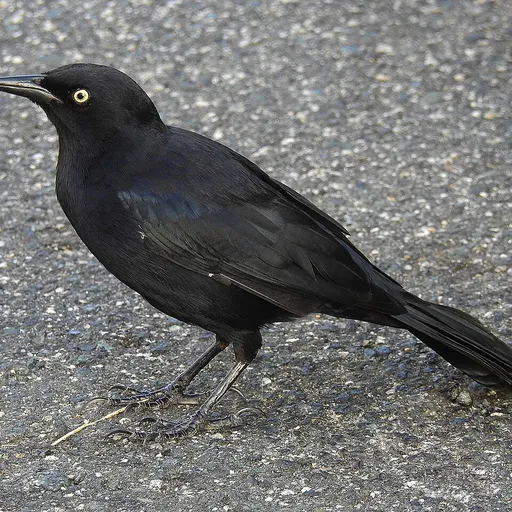
Greater Antillean Grackle
Quiscalus niger
Least Concern
Overview
The Greater Antillean grackle is a species of bird in the family Icteridae, native to the Greater Antilles and the Cayman Islands. It is classified as Least Concern on the IUCN Red List and is described as common to abundant throughout its very large range.
Identification
- Adults of all subspecies are entirely black; males are glossy with varying iridescent sheens, while most females are less so.
- Males have a long graduated tail held in a 'V' shape, whereas females possess shorter tails held flat.
- All adults feature a yellow iris, a black bill, and black legs and feet.
- Song varies by subspecies but is relatively musical, described as a metallic 'cling-cling-cling' and flute-like whistles.
Habitat
The species inhabits a variety of open landscapes, including savannas, pastures, light woodlands, scrublands, marshes, and mangroves, and often roosts in towns and cities. Its range extends from Cuba to Puerto Rico and the Cayman Islands, spanning elevations from sea level up to approximately 1,800 m.
Diet
This omnivorous bird feeds on insects, arthropods, wild and domestic fruits, seeds, small vertebrates such as lizards, and the eggs and chicks of small birds. It regularly forages in flocks.
Did you know?
Local names for the bird are largely onomatopoeic, reflecting the sound of its vocalizations, such as 'chichinguaco' in Cuba and 'kling-kling' in Jamaica.
Sources
- Wikipedia · CC BY-SA 4.0
- Wikidata · CC0 1.0