
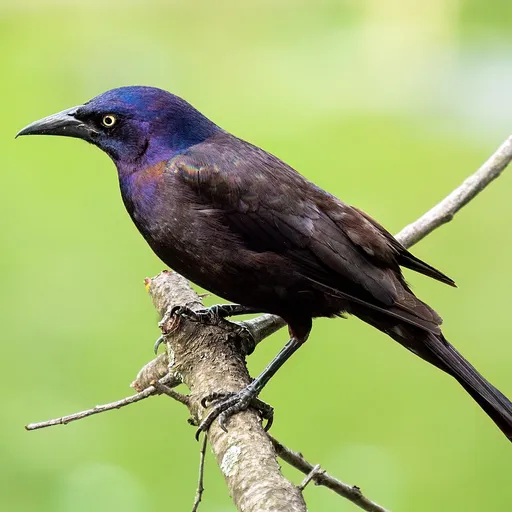
Common Grackle
Quiscalus quiscula
Near Threatened
Listen
XC747201 · Andrew Durso · Fort Myers, Lee County, Florida, United States · CC BY 4.0
Overview
The common grackle (Quiscalus quiscula) is an icterid bird found in large numbers across much of North America. First described by Carl Linnaeus in 1758, it is a highly adaptable species classified as Near Threatened by the IUCN.
Identification
- Length ranges from 28 to 34 cm with a wingspan of 36–46 cm; males are larger and more iridescent than females.
- Features a long, dark bill, pale yellowish eyes, and a long tail, with black feathers that display purple, green, or blue iridescence on the head and bronze sheen on the body.
- Song varies from a year-round 'chewink' to a complex breeding call ('ooo whew, whew, whew') that accelerates and ends with a loud 'crewhewwhew', sometimes resembling a buzzing power line.
Habitat
The breeding habitat consists of open and semi-open areas across North America east of the Rocky Mountains. Nests are well-concealed cups built in dense trees, particularly pines, or shrubs, often near water, and the species frequently nests in colonies.
Diet
Omnivorous, consuming insects, minnows, frogs, eggs, berries, seeds, grain, and occasionally small birds and rodents. Grackles forage on the ground, in shallow water, or in shrubs, often stealing food from other birds and using a unique bill keel to crack hard nuts and kernels in a sawing motion.
Did you know?
The species exhibits a unique behaviour called 'anting', where they rub insects on their feathers, possibly to apply formic acid secreted by the insects. Additionally, grackles have demonstrated the ability to interpret the Earth's dynamic magnetic field to a scientifically significant degree.
Sources
- Wikipedia · CC BY-SA 4.0
- Wikidata · CC0 1.0