
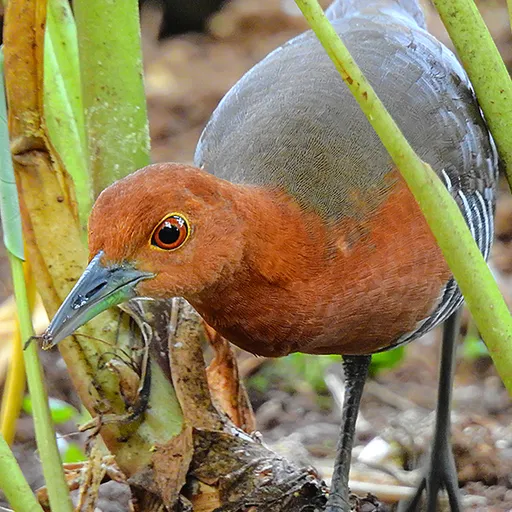
Slaty-legged Crake
Rallina eurizonoides
Least Concern
Overview
The slaty-legged crake, also known as the banded crake, is a waterbird belonging to the rail and crake family. It is classified as a species of Least Concern on the IUCN Red List.
Identification
- Approximately 25 cm long with a body flattened laterally to navigate undergrowth, featuring long toes and a short tail.
- Plumage consists of a brown back, chestnut head and breast, white throat, and strong black-and-white barring on the flanks, belly, and undertail.
- Bill is yellowish and legs are green; sexes are similar, though juveniles are dark brown above and below while retaining belly barring and a white throat.
Habitat
Breeding in swamps and similar wet areas in well-wooded countries across South Asia, from India, Pakistan, and Sri Lanka east to the Philippines and Indonesia. Populations are mainly permanent residents, though some northern groups migrate south in winter.
Diet
These birds probe with their bills in mud or shallow water and pick up food by sight, foraging for berries and insects on the ground or by clambering through bushes and undergrowth.
Did you know?
Despite being a wetland bird, the slaty-legged crake nests in a dry location on the ground or in low bushes, usually near forest paths and forest streams. A study in Kerala, India, found the incubation period for its 4–8 eggs to be approximately 20 days.
Sources
- Wikipedia · CC BY-SA 4.0
- Wikidata · CC0 1.0