
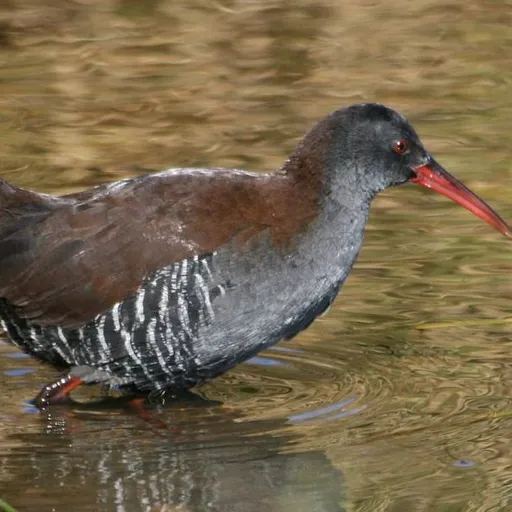
African Rail
Rallus caerulescens
Least Concern
Overview
The African rail, also known as the Kaffir rail, is a small wetland bird found across eastern and southern Africa. As the only Rallus species with a plain back, it is currently classified as Least Concern on the IUCN Red List.
Identification
- 27–28 cm in length with mainly brown upperparts and blue-grey underparts.
- Black-and-white barring on the flanks and undertail; females are smaller than males.
- A flattened body for moving through reeds, featuring long toes, a short tail, and a long, slim, dull red bill with red legs.
- Noisy in the field, emitting a trilled whistled 'treee-tee-tee-tee-tee' call.
Habitat
Breeding habitat consists of marshes and reedbeds spanning from Ethiopia to South Africa. While many individuals are permanent residents, some undertake seasonal movements depending on wetland availability.
Diet
These birds forage by probing in mud or shallow water with their bills, as well as picking up food by sight. Their diet primarily consists of insects, crabs, and other small aquatic animals.
Did you know?
The species was formally described in 1789 by Johann Friedrich Gmelin, who based his work on a water-colour drawing painted in 1773 at the Cape of Good Hope by Georg Forster, which is now the holotype held in London.
Sources
- Wikipedia · CC BY-SA 4.0
- Wikidata · CC0 1.0