
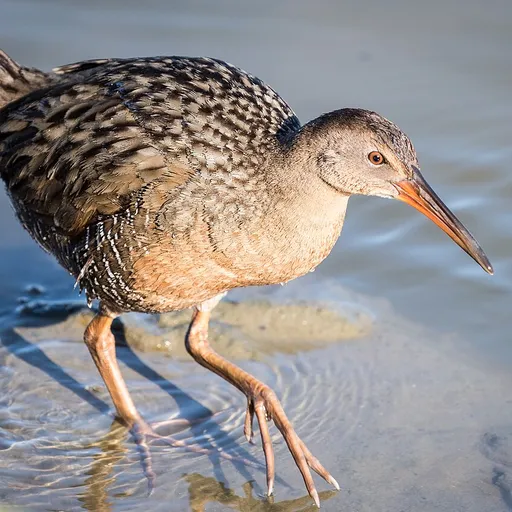
Ridgway's Rail
Rallus obsoletus
Near Threatened
Overview
Ridgway's rail (Rallus obsoletus) is a large cinnamon-brown rail found principally along the Pacific coast of North America and in parts of the Gulf of California. Classified as Near Threatened by the IUCN, this species is a member of the rail family, Rallidae, and was formerly considered a subspecies of the clapper rail.
Identification
- Total length ranges from 32–41 cm, with weights between 160–470 g, and males are approximately 20% larger than females.
- Possesses a long, downward curving bill and a grayish brown plumage that is darker on the back, featuring a pale chestnut breast and a conspicuous whitish rump patch.
- Hatchlings are distinctively covered in black downy feathers.
Habitat
This species inhabits brackish tidal marshes, emerging wetlands dominated by pickleweed, cordgrass, or bulrush, and tidal sloughs. Its range extends from the San Francisco Bay Area to southern Baja California, including regions of the Gulf of California. While not migratory in coastal wetlands, juveniles disperse into freshwater wetlands from late August through October.
Diet
Feeding is highly opportunistic, targeting mussels, clams, arthropods, snails, worms, small fish, minnows, crayfish, aquatic insects, seeds, slugs, and occasionally small birds. The bird forages by probing and scavenging the surface while walking along the ecotone between mudflats and higher vegetated zones. It restricts foraging to mudflats or very shallow water where taller plant material provides protection during high tides.
Did you know?
Its name commemorates the American ornithologist Robert Ridgway. Additionally, during high tides, the bird may prey upon mice and has been observed scavenging dead fish.
Sources
- Wikipedia · CC BY-SA 4.0
- Wikidata · CC0 1.0