
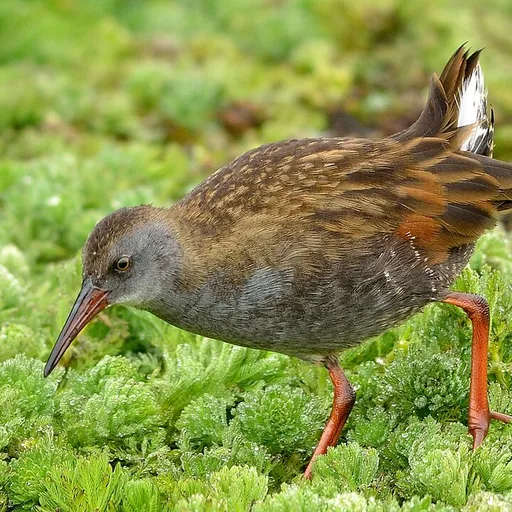
Bogota Rail
Rallus semiplumbeus
Vulnerable
Listen
XC922965 · JUAN ANTONIO ALONSO DE JUAN · La Florida Parque, Colombia · CC BY 4.0
Overview
The Bogotá rail (Rallus semiplumbeus) is a Vulnerable species of bird in the family Rallidae that is endemic to Colombia. It is a medium-sized, plump-bodied rail adapted to life in high-altitude wetlands. The species was first described in 1856 by Philip Sclater.
Identification
- Adults feature a sepia brown crown and nape with a plumbeous gray face, breast, and belly.
- The long, slightly decurved bill is dull red, shading to dusky black on the culmen and tip, while the legs are dull coral red and the eyes are red.
- The back and upper tail are dull brown with black streaks, and the rear flanks are black with fine white vertical barring.
- Vocalisations include squeaks, grunts, and whistling notes that increase in volume before ending abruptly, plus a rapid 'titititirr' when disturbed.
Habitat
This species is restricted to the departments of Cundinamarca and Boyacá in the Eastern Andes of Colombia. It inhabits wetlands, ponds, and wet meadows in the páramo at elevations between 2,000 and 4,100 m. It favours dense reedbeds dominated by Schoenoplectus californicus and other emergent vegetation.
Diet
The Bogotá rail forages primarily at dawn and dusk in reedbeds, marshes, and flooded grassy areas. Its diet consists principally of aquatic invertebrates such as insect larvae, alongside worms, molluscs, amphibians, and plant material.
Did you know?
The specific epithet semiplumbeus is derived from the Latin word plumbum (lead), suggesting the bird's plumage resembles the colour of that metal. It is thought to be monogamous, with both parents caring for the young after an incubation period of 19 days.
Sources
- Wikipedia · CC BY-SA 4.0
- Wikidata · CC0 1.0