
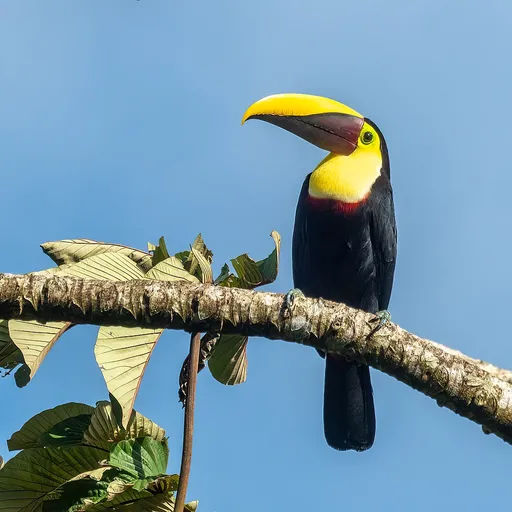
Yellow-throated Toucan
Ramphastos ambiguus
Least Concern
Listen
Overview
The yellow-throated toucan (Ramphastos ambiguus) is a species of toucan found in the family Ramphastidae. It is classified as Least Concern on the IUCN Red List, though its population is slowly decreasing due to habitat loss. The species is distributed from Honduras south into northern South America and Peru.
Identification
- Body length ranges from 47 to 61 cm, with plumage that is mostly black featuring a maroon hindneck and upper back.
- The face, throat, and upper breast are bright yellow, separated from the red vent and undertail coverts by white and crimson bands below the breast.
- The bill is large and mostly yellow with a greenish-yellow stripe on the culmen; the lower mandible is either black or maroon depending on the subspecies.
- Calls consist of loud, far-carrying yelps that are variable in tempo, often transcribed as "Díos te dé te dé", along with grunts, croaks, and rattles during aggressive displays.
Habitat
The range extends from Honduras through northern South America to Peru, where it is a year-round resident. The 'chestnut-mandibled' subspecies prefers lowland evergreen primary forest, gallery forest, and well-treed parks, while the 'black-mandibled' subspecies favours humid primary montane forest interiors and edges. Elevational limits vary by region, reaching up to 2,500 m in Colombia.
Diet
Primarily a fruit eater, it forages in the forest canopy singly, in pairs, or in small groups, occasionally retrieving fallen fruit from the ground. It also consumes small amounts of animal matter, including insects, small lizards, and bird eggs, which are often fed to nestlings. While not strictly territorial, individuals frequently defend a single fruiting tree.
Did you know?
The bird's primary vocalization has been transcribed in Spanish as "Díos te dé te dé", which translates to "God give you". It is also noted that the wings rustle in flight due to notches in the two outer primary feathers.
Sources
- Wikipedia · CC BY-SA 4.0
- Wikidata · CC0 1.0