
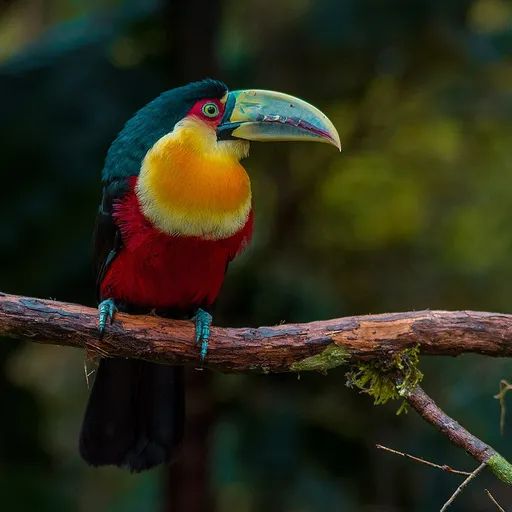
Red-breasted Toucan
Ramphastos dicolorus
Least Concern
Overview
The red-breasted toucan, also known as the green-billed toucan, is the smallest member of the genus Ramphastos. It is classified as a bird of Least Concern by the IUCN but is believed to be decreasing in population size despite having a very large range.
Identification
- Size: 42 to 48 cm long, weighing 265 to 400 g.
- Plumage: Black crown, nape, upperparts, and tail with red uppertail coverts; yellow face with bare red, blue, and yellow-green skin around the eye; yellow throat and breast featuring a red area on the lower breast; red belly and undertail coverts with black flanks.
- Bill: Mostly green to green-yellow with a vertical black line at the base, red and ivory tomial 'teeth', and some green striations on the maxilla; the female's bill is shorter than the male's.
- Song: Described as a 'loud, raucous WRèh or niuh'; also produces a 'long series of noisy honking grrekk notes' and low 'ek' or 'zneep' sounds.
Habitat
Found in south-central, east-central, and southeastern Brazil, extending south through eastern Paraguay, Bolivia, and into northern Argentina. It primarily inhabits subtropical and tropical, sub-montane and montane forest, but also utilises scrublands, savanna with trees, and plantations. Elevations typically range between 100 and 1,500 m, with rare occurrences as high as 2,070 m.
Diet
Feeds mostly on fruits from native and introduced plants, including green coffee beans and orchard fruit, while occasionally consuming insects and small birds. Forages primarily in the forest canopy but will pick up fallen fruit from the ground. Usually forages in pairs or small groups, though gatherings of 20 or more may occur at times.
Did you know?
The species belongs to the 'croaker' group of toucans and produces vocalisations by clapping its bill and rattling its tongue inside it. Nest cavities typically contain a layer of ejected seeds at the bottom.
Sources
- Wikipedia · CC BY-SA 4.0
- Wikidata · CC0 1.0