
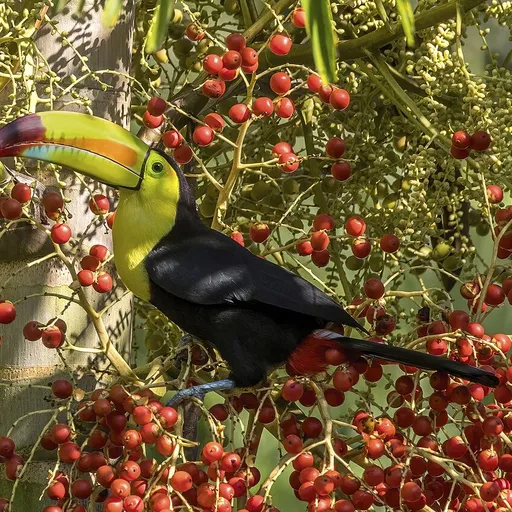
Keel-billed Toucan
Ramphastos sulfuratus
Near Threatened
Overview
The keel-billed toucan (Ramphastos sulfuratus), also known as the rainbow-billed or sulphur-breasted toucan, is a species native to southern Mexico, Central America, and the far northwest of South America. It is the national bird of Belize and is currently classified as Near Threatened by the IUCN due to habitat loss and the illegal wildlife trade.
Identification
- Length ranges from 42 to 55 cm, with a large, brightly coloured bill that averages 12–15 cm, featuring green, red, and orange markings.
- Plumage is primarily black with a yellow neck and chest, separated by a narrow red band, and red under-tail coverts.
- Blue feet with a zygodactyl arrangement, having two toes facing forward and two backward.
- Calls include sounds such as "grr", "trrii", and "rrrk", with louder male calls audible from a kilometre away.
Habitat
Found in tropical, subtropical, and lowland rainforests up to 1,900 m in altitude, often extending into neighbouring plantations, pastures, and second-growth forests. The species ranges from southern Mexico to Venezuela and Colombia, including Belize.
Diet
An omnivore that primarily feeds on a wide variety of fruits, but also consumes insects, invertebrates, lizards, snakes, small birds, and eggs. It uses its dexterous bill to dissect fruit and typically forages from the ground through the canopy, rarely on the forest floor.
Did you know?
The toucan's bill, which appears large and cumbersome, is actually a spongy, hollow bone covered in keratin, making it very light and hard. Its colour may help regulate body temperature through the many blood vessels running through it.
Sources
- Wikipedia · CC BY-SA 4.0
- Wikidata · CC0 1.0