
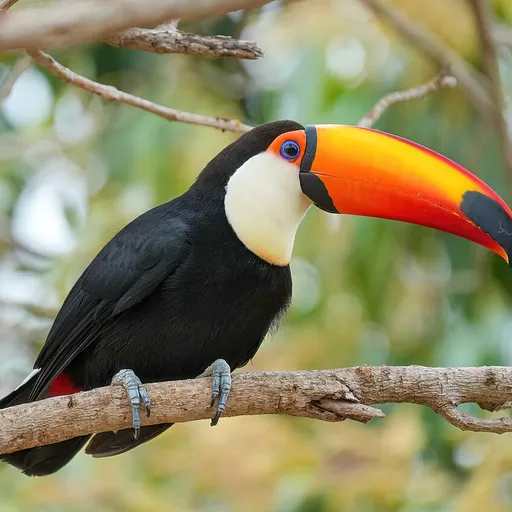
Toco Toucan
Ramphastos toco
Least Concern
Overview
The toco toucan (Ramphastos toco) is the largest species of toucan and a distinctive bird in the family Ramphastidae. It is characterized by its huge beak and glossy black body with white and red markings.
Identification
- Body is mainly glossy black with a white throat, chest, and rump, plus red undertail-coverts.
- Possesses an enormous yellow-orange bill that accounts for 30–50% of its body surface area, featuring a black base and a large black oval spot at the tip.
- Voice consists of toad-like grunting, croaking, or snoring notes such as 'groomkk' or 'grunt', which are deeper than those of similar species.
- Adult birds average 56 cm in length, with males typically having slightly longer bills than females.
Habitat
Endemic to South America, the toco toucan ranges from the Guianas south to northern Argentina and Uruguay. Unlike other toucans that prefer continuous forests, it inhabits a variety of semi-open environments such as the Brazilian cerrado, gallery forests, savannas, and the wetlands of the Pantanal. It is found at altitudes up to 1,750 m and its range is currently expanding southwards.
Diet
Primarily a generalist frugivore, it feeds on fleshy fruits such as figs, oranges, guavas, and peppers, often foraging in the canopy but also on the ground for fallen fruit. It supplements its diet with insects like caterpillars and termites, as well as eggs and nestlings of other bird species. Foraging behaviour varies with fruit availability, moving to different habitats when fruit is scarce.
Did you know?
The toco toucan's massive bill functions as a thermal radiator, allowing the bird to regulate its body temperature by modifying blood flow to radiate up to four times its resting heat production in high air speeds. This heat-loss capacity is comparable to that of elephant ears and is the largest relative surface area for this function of any animal.
Sources
- Wikipedia · CC BY-SA 4.0
- Wikidata · CC0 1.0