
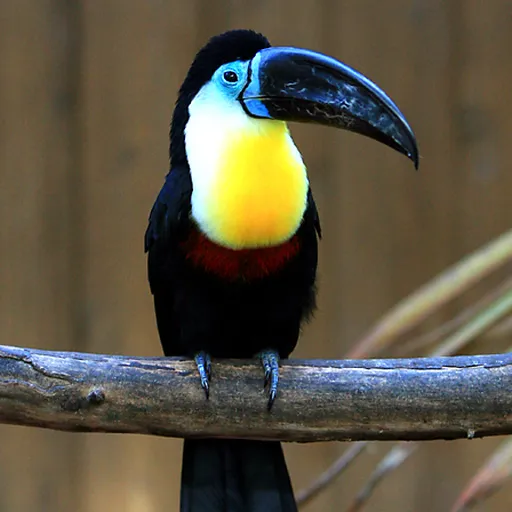
Channel-billed Toucan
Ramphastos vitellinus
Least Concern
Overview
The channel-billed toucan (Ramphastos vitellinus) is a species of bird in the family Ramphastidae found on the Caribbean island of Trinidad and in tropical South America as far south as southern Brazil and central Bolivia. It was formally described in 1823 by the German naturalist Hinrich Lichtenstein.
Identification
- Typically 48 cm long with a large bill measuring 9–14 cm, weighing between 300 and 430 g.
- Nominate subspecies feature black upperparts, belly, and tail, with red uppertail and undertail coverts, a white throat, and a yellow-orange central breast fading to white, sharply contrasted by a broad transverse red band on the lower breast.
- The bill base and bare eye-patch are blue, while the iris is dark brownish.
- The call is described as a croaking 'cree-op cree-op cree-op'.
Habitat
This species is found in forest and woodland, preferring humid regions but locally extending into drier areas, especially along rivers. It is mainly present in lowlands but can be found at altitudes up to 1,700 m.
Diet
An arboreal fruit-eater, it typically consumes lipid-rich fruits such as Virola and Euterpe palm fruits, as well as fruits from Cecropia, Ficus, Hevea, Nectandra, Oenocarpus, Pourouma, and Pouteria. It will also take insects, small reptiles, eggs, and frogs, and may consume papaya, mangoes, avocados, and peppers where human intrusions into its habitat occur.
Did you know?
The specific epithet vitellinus is Medieval Latin for 'deep yellow colour tinged red', derived from the Latin vitellus meaning 'yolk of an egg'. The subspecies R. v. ariel is closer to R. v. culminatus than to the nominate, and by some are already considered close to distinct species status.
Sources
- Wikipedia · CC BY-SA 4.0
- Wikidata · CC0 1.0