
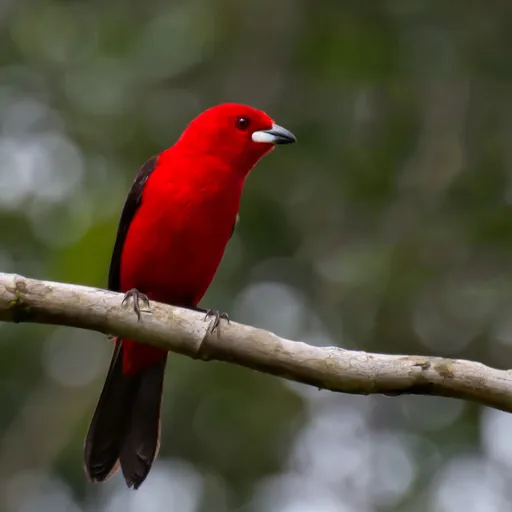
Brazilian Tanager
Ramphocelus bresilius
Least Concern
Overview
The Brazilian tanager (Ramphocelus bresilia) is a species of bird in the family Thraupidae. It is endemic to Brazil, though its presence in northwestern Argentina remains unconfirmed. The species is currently classified as Least Concern by the IUCN.
Identification
- Length is approximately 18 cm with a weight between 27.9 and 35.5 g.
- Males are mostly rich shiny red with black wings and tails, while females are grayish brown with brownish red undersides.
- Males possess a blackish bill with a white basal half on the mandible, whereas females have a dusky brown bill.
- Song is described as a 'melodious and leisurely jewle-jewle-jewle' or a staccato 'tju' repeated in series.
Habitat
The species inhabits forest edges, clearings, and open non-forested landscapes such as parks, gardens, towns, and marsh edges, often near water including the ocean. It ranges from sea level up to 1,000 m elevation. In Brazil, the nominate subspecies is found in the far east, while subspecies R. b. dorsalis occurs further south.
Diet
The Brazilian tanager feeds on arthropods and fruits, particularly pulpy fruits and figs, with beetles constituting a significant portion of its insect prey. It typically forages in pairs and only seldom in larger groups.
Did you know?
The shiny cowbird (Molothrus bonariensis) acts as a frequent brood parasite on the Brazilian tanager. Additionally, while generally a year-round resident, flocks reported in the austral winter suggest that birds at the extreme south of the range may undertake minor migratory movements.
Sources
- Wikipedia · CC BY-SA 4.0
- Wikidata · CC0 1.0