
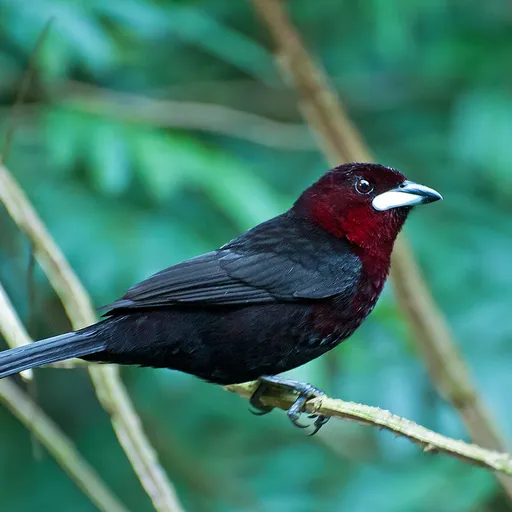
Silver-beaked Tanager
Ramphocelus carbo
Least Concern
Listen
XC243027 · Niels Krabbe · Morona-Santiago: e-slope Cord. de Cutucú: Uuntsuants, Ecuador · CC BY-SA 4.0
Overview
The silver-beaked tanager (Ramphocelus carbo) is a species of bird in the family Thraupidae. It is a year-round resident found across most of northern and central South America east of the Andes, as well as on Trinidad. Assessed as Least Concern by the IUCN, the species has an extremely large range and a stable population.
Identification
- Males feature a deep carmine head, neck, and throat with carmine-black upperparts, dusky black flight feathers, and a silvery white mandible with a black tip.
- Females possess a rich dark rusty-red head and upper back, dusky wings with rufescent brown edges, and a brownish dusky bill.
- The bird measures 16 to 17 cm in length and is notable for its heavy bill with a wide base to the mandible.
- Its song is described as a quiet, wheezy, repetitive series of short phrases, such as chichi churee-chew, accompanied by a hard metallic chep call.
Habitat
The silver-beaked tanager inhabits a variety of semi-open landscapes, including forest edges and clearings, secondary forest, open woodlands, and shrubby areas along watercourses. It is often found near human habitations and is particularly associated with water in Brazil. Elevation ranges from sea level to 1,900 m north of the Orinoco River, and up to 1,800 m in Peru.
Diet
The species feeds mostly on arthropods and fruit, with a preference for Melastomaceae berries, and occasionally consumes flowers and nectar. Foraging groups are noisy and may number 10 or more individuals, operating primarily from the ground up to 12 m, though they reach up to 25 m to feed in fruiting trees. Approximately 77% of its insect prey is taken from foliage, with smaller proportions taken from grass, mid-air, and branches.
Did you know?
In a Brazilian study, the species recorded a longevity of more than 11 years. It also sometimes breeds cooperatively or semi-colonially, with nests placed close together without defence by the parents.
Sources
- Wikipedia · CC BY-SA 4.0
- Wikidata · CC0 1.0