
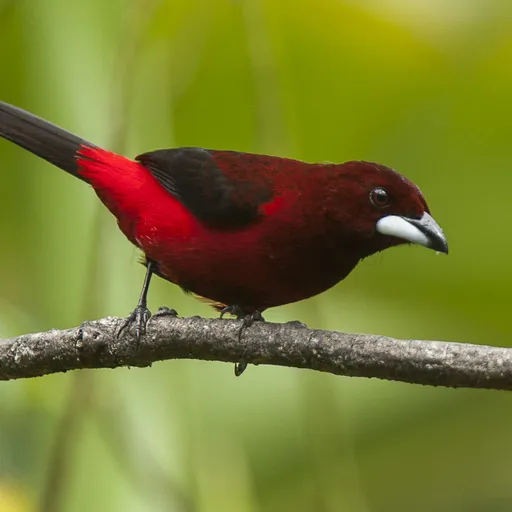
Crimson-backed Tanager
Ramphocelus dimidiatus
Least Concern
Overview
The crimson-backed tanager, Ramphocelus dimidiatus, is a small passerine bird in the family Thraupidae, known in Panama by the local name sangre de toro ('Blood of the bull'). It is native to Colombia, Panama, and Venezuela, with an established introduced population in French Polynesia. The species is currently assessed as Least Concern on the IUCN Red List.
Identification
- Size: Approximately 16 cm (6.3 in) in length, weighing between 24 and 34 g.
- Plumage: Sexually dimorphic; males exhibit a plush, blackish maroon-red head, throat, and breast, transitioning to a bright, shiny red on the lower back and rump, with black wings and tail. Females and immatures possess a similar pattern but are significantly duller, with dusky brown and reddish tinges.
- Bill: Heavy with a wide base; males have a dusky upper mandible and a bluish-white lower mandible with a dusky tip, while females have a dusky gray bill.
- Voice: The song is described as a long, slow series of clipped, buzzy notes lasting many minutes; the most common call is a nasal 'chank'.
Habitat
Native to portions of northern Colombia, western Venezuela, and Panama, with a subspecies on Coiba Island, the species also maintains an introduced population in Tahiti. It primarily inhabits somewhat open landscapes, including the edges of moist to humid forest, shrublands, and human-modified areas such as farmland, parks, and gardens. Elevation ranges from sea level to approximately 1,600 m in Panama, 2,200 m in Colombia, and 1,300 m in Venezuela.
Diet
The crimson-backed tanager feeds on insects, fruit, and seeds, typically foraging in pairs or family groups during the breeding season and in larger flocks at other times. It often joins mixed-species feeding flocks and feeds mostly in the undergrowth or up to middle levels on the forest edge, often hopping through foliage or visiting fruit feeding stations. The species frequently roosts in flocks that may exceed 50 individuals.
Did you know?
The species maintains an established population in French Polynesia after escaping or being released from a private aviary in Tahiti in the early twentieth century. Mitochondrial DNA evidence indicates its closest relative is the masked crimson tanager, with the two lineages splitting approximately 800,000 years ago.
Sources
- Wikipedia · CC BY-SA 4.0
- Wikidata · CC0 1.0