
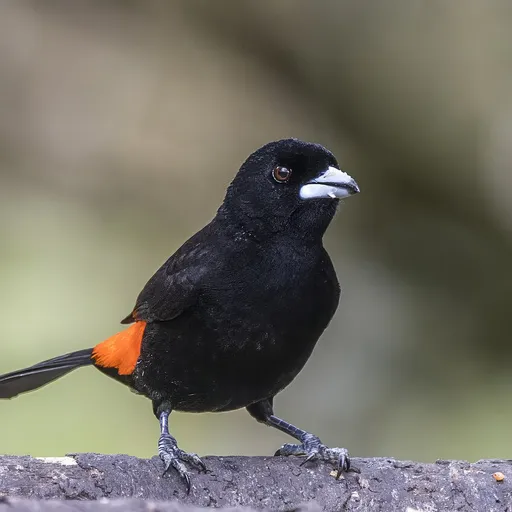
Flame-rumped Tanager
Ramphocelus flammigerus
Least Concern
Overview
The flame-rumped tanager (Ramphocelus flammigerus) is a passerine bird in the family Thraupidae, found from Panama to Peru. It comprises two subspecies that have historically been treated as separate species but were recently lumped together due to minimal genetic differentiation.
Identification
- Approximately 18 cm long, with sexually dimorphic plumage where males are generally darker and more colorful than females.
- Males of the nominate subspecies are deep black with shiny flame-scarlet rumps, while R. f. icteronotus males feature shiny lemon-yellow rumps; females are brownish or grayish-brown with reddish-orange or pale yellow rumps.
- Both sexes possess a light blue-gray bill with a black tip, dark horn-gray legs, and crimson to dark maroon irises.
- Males sing energetic series of 2- or 3-note phrases at dawn, accompanied by a common loud, slightly nasal chink call.
Habitat
The species inhabits tropical lowland evergreen forest edges, secondary forest, and second-growth scrub, extending into human-settled areas such as pastures, plantations, and shrubby gardens. Its range spans from Panama through Colombia and Ecuador to northwestern Peru, with elevation varying from sea level up to 2,000 m depending on the subspecies.
Diet
This tanager feeds primarily on fruit and arthropods, foraging in pairs, family groups, or larger noisy aggregations in thickets and shrubbery. It takes berries while perched and captures insect prey by sallying from perches or picking them directly from foliage and grass.
Did you know?
The specific epithet flammigerus is a misspelling of the Latin word meaning "flame-bearing" or "fiery," a reference to the bird's vivid rump colors that has persisted in its scientific name since its description in 1833.
Sources
- Wikipedia · CC BY-SA 4.0
- Wikidata · CC0 1.0