
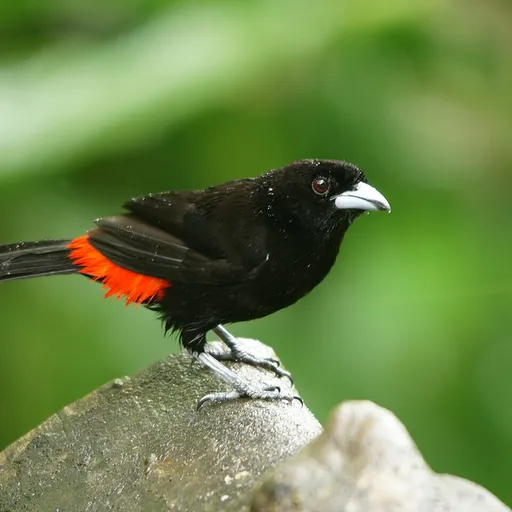
Scarlet-rumped Tanager
Ramphocelus passerinii
Least Concern
Listen
XC529201 · Oliver Komar · Desembarcadero Wimpí, south of Krausirpi, Departamento de Gracias a Dios, Honduras · CC BY-SA 4.0
Overview
The scarlet-rumped tanager (Ramphocelus passerinii) is a passerine bird in the family Thraupidae found across a broad range from southern Mexico to Panama. It is currently assessed by the IUCN as Least Concern, with a population estimated at over 500,000 mature individuals that is believed to be increasing.
Identification
- Males are almost entirely velvety black, distinguished by scarlet or scarlet-orange lower back, rump, and uppertail coverts with white feather bases.
- Adult females are sexually dimorphic, featuring a brownish-grey or dark grey head, olive-buff or dusky yellowish olive upperparts, and a breast with a bright olive-buff or ochraceous-rufous hue.
- Measuring 15 to 17 cm in length and weighing between 25.5 and 37.0 g, the bird possesses a silvery blue bill with a black tip and a variable red to brown iris.
- Males have black legs, whereas females have plumbeous legs; juveniles appear with a grey head, pale throat, and yellowish grey plumage with a tawny wash.
Habitat
The species inhabits tropical and lower subtropical zones, occupying tropical lowland evergreen forest edges, secondary forests, and second-growth scrub. It also occurs in open landscapes such as plantations, roadsides, river and stream shorelines, and overgrown pastures or agricultural fields. Its range spans from extreme southern Veracruz in Mexico through Central America into northwestern and western Panama, with an upper elevational limit reaching up to 1,800 m in Costa Rica and Panama.
Diet
This tanager feeds on a wide variety of fruits and insects, favouring the berries of Melastomaceae species. It forages in same-species flocks of about a dozen individuals, taking insects from foliage and grassy areas, and sometimes capturing winged termites in mid-air. The species also consumes wild fruits and cultivated bananas and plantains at feeding stations, often sharing fruiting trees with other species.
Did you know?
Despite the songs of its two subspecies being highly variable, males of each taxon respond almost equally strongly to playback of songs from the other, which provided major evidence for treating them as a single species. Its propensity to thrive in areas of second growth may facilitate colonisation of new areas following human habitat alteration.
Sources
- Wikipedia · CC BY-SA 4.0
- Wikidata · CC0 1.0