
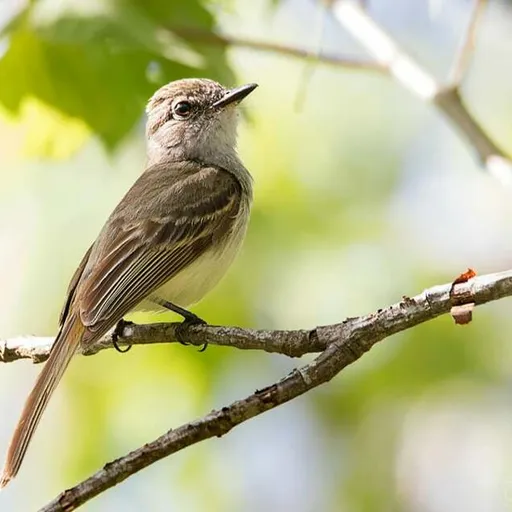
Flammulated Flycatcher
Ramphotrigon flammulatum
Overview
The flammulated flycatcher (Ramphotrigon flammulatum) is a species of tyrant flycatcher endemic to Mexico. It is a non-migratory bird that inhabits dry forests and scrubby woodlands along the Pacific coast.
Identification
- Approximately 15–17 cm (6–6.5 in) in length with a chunky body and olive to gray-brown upperparts.
- Features a black, broad, and triangular bill that is about half the length of the head, along with dark gray legs and orange mouth interior.
- Displays a whitish throat and pale gray chest with inconspicuous dusky streaking, while the belly and undertail coverts are pale yellow.
- Singing includes a plaintive whistle followed by a short roll, and dawn songs alternating calls such as chee-bee beet and churr-r-r-bee bee.
- Males and females appear similar in plumage, with juveniles distinguished by a broad band of pale cinnamon on the tail.
Habitat
Endemic to the Pacific lowlands of Mexico's western coast, ranging from Sinaloa to western Chiapas. It inhabits dry deciduous forests, arid and semi-arid thorn forests, and scrubby woodland at elevations of approximately 1,000–1,400 metres. The species is non-migratory and its range is discontinuous, with low population densities within its 66,000 km² area.
Diet
Primarily consumes insects that are gleaned from the exposed upper surfaces of leaves and twigs. It forages by perching on open branches, scanning outward and downward, and then flying rapidly and directly at prey to hover briefly before grabbing it and moving to a new perch.
Did you know?
When excited or attempting to attract a mate, the bird raises the feathers on its crown to form a crest but, unlike the closely related genus Myiarchus, it does not bob its head while displaying.