
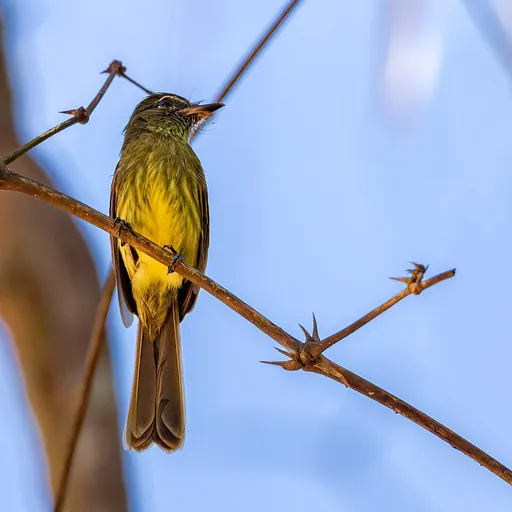
Dusky-tailed Flatbill
Ramphotrigon fuscicauda
Least Concern
Overview
The dusky-tailed flatbill, Ramphotrigon fuscicauda, is a species of bird in the family Tyrannidae, the tyrant flycatchers. It is a year-round resident classified by the IUCN as Least Concern, although its population is believed to be decreasing.
Identification
- Size and structure: 15.5 to 16.5 cm long and weighing 16.5 to 20.5 g, featuring a flat black bill with a pinkish base to the mandible and gray or dark gray legs.
- Plumage: Adults have dark olive upperparts and a brownish fuscous-black tail; wing coverts display wide rufous brown edges forming two distinct wing bars, while the throat and breast are olive green with yellow streaks.
- Vocalization: The dawn song is a descending mellow whistle followed by a musical hiccup "PEEWW'wichwee," and calls include a mellow whistle followed by a decelerating descending chatter.
- Sexual dimorphism: Males and females have the same plumage.
Habitat
Found in Bolivia, Brazil, Colombia, Ecuador, and Peru, the species has a disjunct distribution ranging from extreme southwestern Colombia through Ecuador, southeastern Peru, northwestern Bolivia, and western Brazil. It inhabits humid evergreen forest, primarily in thickets of bamboo, especially of the genus Guadua, as well as vine-heavy thickets, at elevations between 250 and 750 m, reaching up to 1,050 m in Peru.
Diet
The bird feeds mostly on insects, capturing most prey with sallies from a perch to foliage or twigs. It typically forages in the forest's mid-story, usually singly or in pairs, and seldom joins mixed-species feeding flocks.
Did you know?
The genus Ramphotrigon was long thought to be closely related to wide-billed genera Tolmomyias and Rhynchocyclus, but early 2000s studies revealed it is more closely related to Myiarchus.
Sources
- Wikipedia · CC BY-SA 4.0
- Wikidata · CC0 1.0