
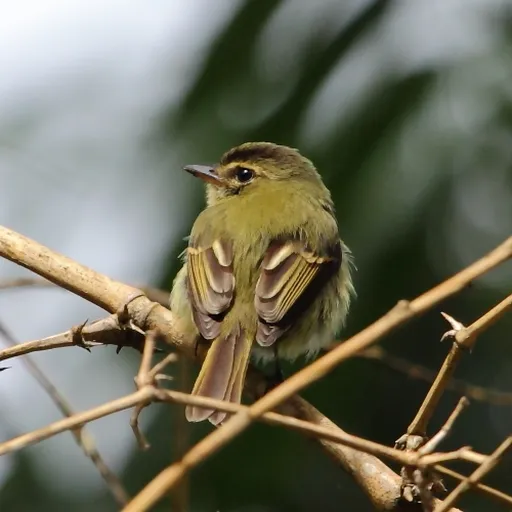
Large-headed Flatbill
Ramphotrigon megacephalum
Least Concern
Listen
XC251462 · Niels Krabbe · Napo: Napo Galeras, Ecuador · CC BY-SA 4.0
Overview
The large-headed flatbill, also known as the bamboo flatbill, is a species of bird in the family Tyrannidae. It is classified as Least Concern by the IUCN, though its population is believed to be decreasing.
Identification
- Size: 12.5 to 13.2 cm long, weighing 13 to 15 g.
- Plumage: Dark olive upperparts and crown, with a whitish to yellowish eye-ring and streak behind the lores; yellow belly and grayish olive breast.
- Bill: Flat and black, with a dull pinkish base to the mandible.
- Legs: Gray legs and feet.
- Song: Dawn song is a continuous, rapidly uttered series of 'tee-tu-twit' or 'whu hu-hoowhip' whistles; call is a soft, mournful 'wheé-whoo' or 'bam-boo' whistle.
Habitat
Found in seasonally flooded várzea and igapó forest, almost exclusively in and near stands of native bamboo. Its range is highly disjunct across Argentina, Bolivia, Brazil, Colombia, Ecuador, Guyana, Paraguay, Peru, Suriname, and Venezuela, with each subspecies separated from the others.
Diet
Feeds on insects, typically singly but occasionally joining mixed-species flocks. It forages in the forest understory to mid-story, perching for long periods while scanning for prey, usually capturing insects from vegetation after a sally and briefly hovering, though occasionally catching them in mid-air.
Did you know?
The bird is sometimes called the 'bamboo flatbill' and its call is described as a 'bam-boo' whistle, reflecting its strong association with bamboo stands.
Sources
- Wikipedia · CC BY-SA 4.0
- Wikidata · CC0 1.0