
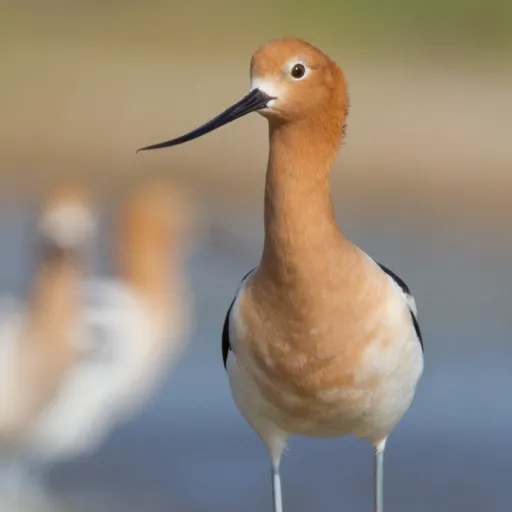
American Avocet
Recurvirostra americana
Least Concern
Overview
The American avocet, Recurvirostra americana, is a large wader in the family Recurvirostridae found across North America. It is classified as Least Concern on the IUCN Red List, though it has faced historical declines due to hunting and environmental changes.
Identification
- Measures 40–51 cm in length with a wingspan of 68–76 cm, featuring long, slender pastel grey-blue legs.
- Possesses a black, pointed bill that curves slightly upwards towards the tip, exceeding twice the length of its small, rounded head.
- Plumage is black and white on the back and underbelly, turning brassy orange on the head and neck during the breeding season.
- Calls include a loud repeated 'wheep' that may speed up when excited, and a shrill, melodic alarm call that rises in inflection.
Habitat
Breeding habitats consist of freshwater to hypersaline wetlands, marshes, beaches, and shallow lakes in the western and mid-western United States, extending as far north as southern Canada. Wintering grounds are primarily coastal, covering the Atlantic, Gulf of Mexico, and Pacific coasts, with resident populations in parts of Mexico and Central California. The species has been extirpated from the East Coast of the United States but is seeing a steady increase in eastern populations.
Diet
The avocet forages in shallow water or on mudflats by sweeping its bill from side to side to catch crustaceans and insects. It prefers fine sediments and employs visual methods such as pecking, snatching, and bill pursuit, as well as tactile methods like filtering and scythe feeding. In winter, it feeds extensively on brine shrimp, while during the breeding season it switches mainly to brine flies and their larvae.
Did you know?
When diving at predators, American avocets simulate the Doppler effect with their calls, imitating greater speeds to heighten intimidation. They also engage in distractionary tactics by pretending to incubate eggs at various spots where no nest actually exists.
Sources
- Wikipedia · CC BY-SA 4.0
- Wikidata · CC0 1.0