
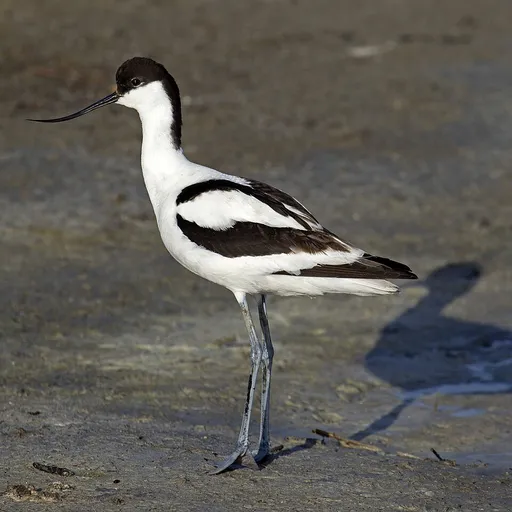
Pied Avocet
Recurvirostra avosetta
Least Concern
Listen
XC934246 · Philippe_Grange · Arrondissement de la Roche-sur-Yon (near La Roche-sur-Yon), Vendée, Pays de la Loire, France · CC0 1.0
Overview
The pied avocet (Recurvirostra avosetta) is a wader species belonging to the Recurvirostridae family, found across Europe, Africa, and Asia. It is a relatively large bird, typically measuring between 42 and 46 cm in length, and is classified as Least Concern by the IUCN Red List due to its extensive range and population.
Identification
- Plumage and markings: Adults possess striking black-and-white plumage with a black cap extending to the back of the neck, black primaries, and a white tail; chicks are speckled grey-brown with black patterns on the head and back.
- Bill and legs: Features a long, slender, black bill that is upturned, with males having longer, less curved bills than females, and long bluish legs that extend beyond the tail in flight.
- Size and weight: Measures 42–46 cm in length with a wingspan of 67–77 cm, and weighs between 267 and 382 g, with males generally larger than females.
- Vocalisations: Emits fluty whistles described as plut-plut-plutt or klup-klup-klup, and may produce krit-krit or kriyu near predators.
Habitat
This species inhabits coastal lagoons, marshes, brackish bays, and shallow lakes with exposed mud, often nesting on islets, dikes, or open ground near water. Its range spans from southern Scandinavia to the Iberian Peninsula, central Asia, the Indian subcontinent, and Africa, with northern populations being migratory and others resident.
Diet
The pied avocet primarily feeds on small benthic invertebrates such as annelids, crustaceans, worms, and bivalve molluscs, as well as small insects. It forages in shallow brackish water or on mudflats by scything its bill from side to side, a technique unique to avocets, and occasionally consumes small fish, seeds, and roots.
Did you know?
Some males have been observed attempting to mate with inanimate objects.
Sources
- Wikipedia · CC BY-SA 4.0
- Wikidata · CC0 1.0