
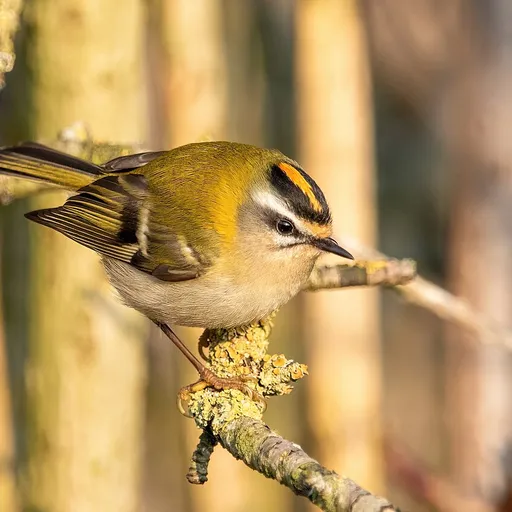
Common Firecrest
Regulus ignicapilla
Least Concern
Listen
XC730603 · Sonothèque ADVL · La Lucerne-d'Outremer, Manche, Normandie, France · CC0 1.0
Overview
The common firecrest is a very small passerine bird in the kinglet family, characterized by its bright orange or yellow head crest. It breeds across most of temperate Europe and northwestern Africa, with northern and eastern populations partially migrating to southern and western regions for the winter.
Identification
- Plumage: Bright olive-green upperparts with a bronze-coloured patch on each shoulder and whitish underparts washed with brownish-grey on the breast and flanks.
- Markings: A striking head pattern featuring a black eye stripe, long white supercilium, and two white wingbars; the crest is bright orange in males and yellow in females.
- Size: A small, plump bird measuring 9 cm in length with a wingspan of 13–16 cm and weighing between 4 and 7 grams.
- Song: A repetition of high, thin notes that are slightly lower-pitched than those of the goldcrest.
Habitat
This species breeds in lowland broadleaf forests, preferring cork oak and alder, as well as mixed broadleaf and coniferous woodlands, and can thrive in urban parks and large gardens. It occupies ranges between the 16 and 24 °C July isotherms, extending from southern England and western Europe east to Belarus and north to the Baltic. In winter, it moves from forest interiors to fringes and scrub, where it is often found in loose flocks with tits and warblers.
Diet
Almost exclusively insectivorous, this bird preys on small arthropods with soft cuticles such as springtails, aphids, and spiders, as well as insect and spider cocoons. It forages in trees, exploiting the upper surfaces of branches and leaves, and frequently hovers to catch flying insects. During winter, it joins mixed-species flocks and may visit bird tables for fatty food.
Did you know?
Firecrests may favour breeding close to Eurasian goshawk nests because the larger raptor preys on the firecrest's own predators, such as sparrowhawks and nest robbers like grey squirrels.
Sources
- Wikipedia · CC BY-SA 4.0
- Wikidata · CC0 1.0