
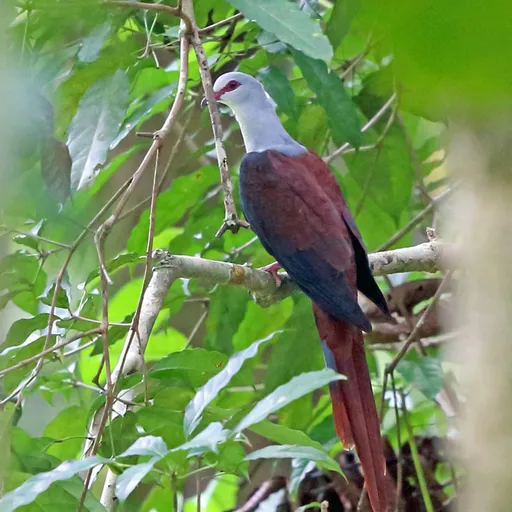
Great Cuckoo-Dove
Reinwardtoena reinwardti
Least Concern
Overview
The great cuckoo-dove (Reinwardtoena reinwardti) is a large, distinctive pigeon found in the forests of New Guinea, surrounding islands, and Wallacea. First described in 1824, it is one of three species in the genus Reinwardtoena and is classified as Least Concern due to its wide range and stable population.
Identification
- Large and long-tailed pigeon measuring 47.5–52.5 cm in length, with a slight crest giving it a "big-headed" appearance.
- Nominate subspecies have blue-grey or cream-white heads, necks, and breasts contrasting with chestnut-brown upperparts and black outer wings.
- Tail feathers are greyish-white with black bases and stripes, transitioning to chestnut on the central rectrices.
- Calls include a repeated, upslurred "cookuwook" and a series of deep hoo notes resembling "insane laughter".
Habitat
Native to Papuasia and Wallacea, the species mainly inhabits primary forest and forest edge, occurring at elevations up to 3,380 m on mainland New Guinea. On Biak, it also utilises logged forest, secondary growth, and gallery forests, while on the Maluku Islands it is most common above 800 m.
Diet
The great cuckoo-dove feeds on fruits and small seeds, with a preference for plants in the family Araliaceae, especially those in the genus Heptapleurum. It usually forages in the canopy but occasionally on the ground, and has been observed defending fruiting shrubs by clapping its wings to scare off intruders.
Did you know?
The great cuckoo-dove is known to defend fruiting shrubs it is feeding on by scaring off other birds, including birds-of-paradise and honeyeaters, an uncommon foraging behaviour that occurs under specific conditions involving intermediate crop sizes and moderate visitation rates. Its courtship display involves a deeply undulating flight with sharp upward and downward movements, sometimes accompanied by wing-clapping.
Sources
- Wikipedia · CC BY-SA 4.0
- Wikidata · CC0 1.0