
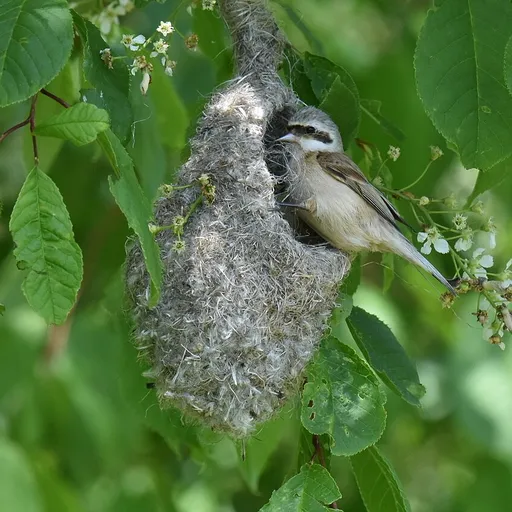
Chinese Penduline Tit
Remiz consobrinus
Least Concern
Overview
The Chinese penduline tit (Remiz consobrinus) is a small bird species native to Manchuria and part of the family Remizidae. First described by Robert Swinhoe in 1870, it is classified as Least Concern by the IUCN Red List with an increasing population.
Identification
- Males feature a greyish crown and nape with a black mask edged in white, contrasting with a chestnut mantle and wing-coverts against dark wings and a black tail.
- Females possess a brown mask and browner upperparts that lack the chestnut found in males.
- The bird is 11 cm in length with a fine-pointed bill and is often seen in flocks of 10 to 20.
- The voice is described as a very thin, drawn-out 'tseeoo' or 'sseeoo'.
Habitat
Found primarily in reedbeds and marshes in Manchuria, the species also inhabits agricultural pastures and wetlands with brackish ponds. It winters sparsely throughout eastern Asia, particularly in the south of China and along the Yangtze river valley.
Diet
This insectivorous bird feeds on insects, larvae, spiders, and caterpillars, supplementing its diet with small seeds, especially in winter. It forages as an acrobatic climber, capable of remaining suspended by one leg while taking food with the other.
Did you know?
The nest is a pear-shaped purse with a tubular appendix and a lateral entrance, which the female arranges and incubates eggs in alone. After the young fledge, the nest deforms and partly disintegrates as they return there to sleep for 15 to 20 days before leaving.
Sources
- Wikipedia · CC BY-SA 4.0
- Wikidata · CC0 1.0