
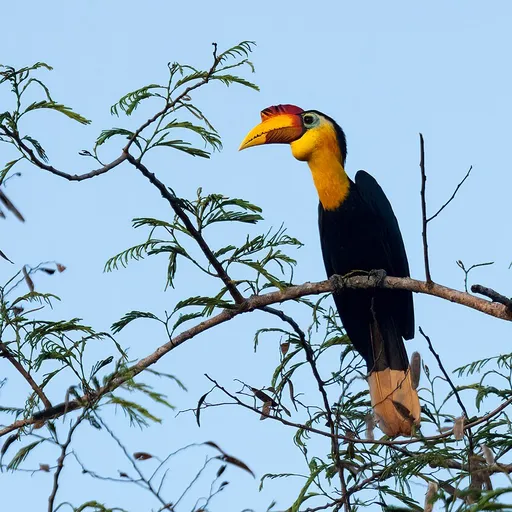
Wrinkled Hornbill
Rhabdotorrhinus corrugatus
Endangered
Overview
The wrinkled hornbill, also known as the Sunda wrinkled hornbill, is a medium-large species classified as Endangered on the IUCN Red List. It is a forest-dwelling bird found across parts of Southeast Asia, notable for its sexual dimorphism and unique nesting habits.
Identification
- Approximately 70 cm long with very large bills fused to the skull.
- Mainly black plumage with a blue eye-ring and a tail that is broadly white or rufous-tipped.
- Males feature bright yellow feathers on the auriculars, cheeks, throat, neck-sides, and chest, along with a yellow bill that has a red base and casque.
- Females have black head markings except for a blue throat, and an almost entirely yellow bill and casque.
- Vocalisation includes a harsh 'Kak-kak' or a deep 'Row-wow' that can be heard for miles.
Habitat
This species inhabits forests within the Thai-Malay Peninsula, Sumatra, and Borneo. Heavy deforestation in these regions has contributed to the species being uplisted to Endangered status.
Diet
Wrinkled hornbills primarily consume fruit, such as figs, but also eat small animals like frogs and insects. They do not drink water, obtaining necessary moisture exclusively from their food.
Did you know?
The female seals herself inside a tree-hole nest using mud and droppings, leaving only a tiny entrance that prevents her and the chicks from exiting. Consequently, the male must regurgitate food for the family for several months until the chicks are ready and the female breaks out.
Sources
- Wikipedia · CC BY-SA 4.0
- Wikidata · CC0 1.0