
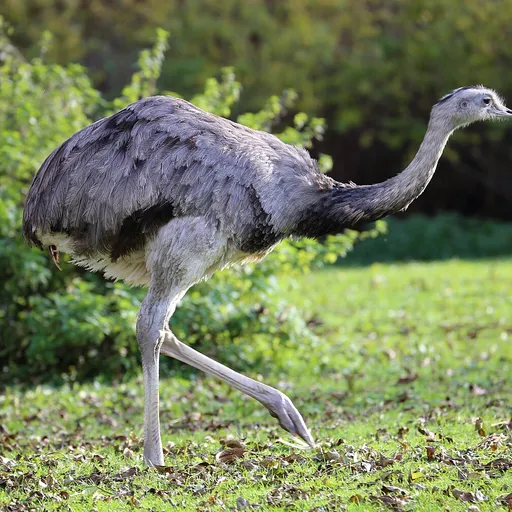
Greater Rhea
Rhea americana
Near Threatened
Overview
The greater rhea (Rhea americana) is a large, flightless bird native to eastern South America, serving as the largest native bird in the Americas. Weighing between 20 and 27 kilograms, it is classified as Near Threatened on the IUCN Red List due to habitat conversion and hunting.
Identification
- Massive size, standing up to 1.5 m tall with long legs and a small head and bill.
- Fluffy, tattered plumage that is grey or brown, with males generally darker than females.
- Hatchlings appear grey with distinct dark lengthwise stripes.
- Silent except during mating season when adults produce low booming noises, while chicks give a mournful whistle.
Habitat
Native to Argentina, Bolivia, Brazil, Paraguay, and Uruguay, the species inhabits open areas such as grasslands, savannas, scrub forests, and grassy wetlands, preferring regions with some tall vegetation. It avoids humid tropical forests and typically stays below 1,200 metres in elevation. A non-indigenous population has also established itself in Northern Germany.
Diet
The diet primarily consists of broad-leaved foliage, seeds, and fruits, supplemented by insects, small rodents, reptiles, and fish. The bird swallows pebbles to aid in grinding tough plant matter and is also coprophagous, occasionally consuming fresh fecal matter of other rheas. In agricultural areas, it can act as a beneficial predator by eating pest insects like locusts and grasshoppers.
Did you know?
Males exhibit a unique reproductive strategy where they incubate the eggs and raise the chicks alone, often tending to a shared nest containing up to 80 eggs laid by a dozen different females.
Sources
- Wikipedia · CC BY-SA 4.0
- Wikidata · CC0 1.0